


Page 133 - (DK) Super Shark Encyclopedia: And Other Creatures of the Deep
P. 133
BURROW


                                                                        BOLTER


                                                                          GARDEN EEL


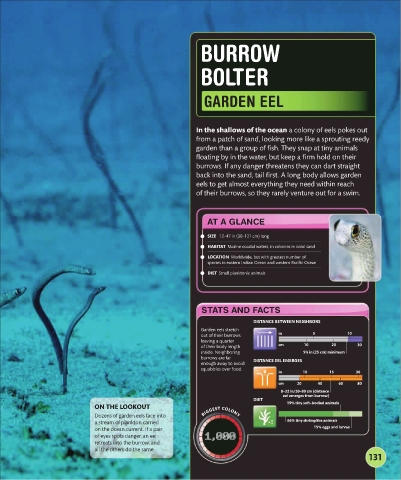
                                                                       In the shallows of the ocean a colony of eels pokes out
                                                                       from a patch of sand, looking more like a sprouting reedy
                                                                       garden than a group of fish. They snap at tiny animals
                                                                       floating by in the water, but keep a firm hold on their
                                                                       burrows. If any danger threatens they can dart straight
                                                                       back into the sand, tail first. A long body allows garden
                                                                       eels to get almost everything they need within reach
                                                                       of their burrows, so they rarely venture out for a swim.


                                                                           AT A GLANCE

                                                                        •  SIZE   12–47 in (30–121 cm) long

                                                                        •  HABITAT  Marine coastal waters, in colonies in coral sand
                                                                        •  LOCATION  Worldwide, but with greatest number of
                                                                           species in eastern Indian Ocean and western Pacific Ocean
                                                                        •  DIET  Small planktonic animals


                                                                         STATS AND FACTS

                                                                                           DISTANCE BETWEEN NEIGHBORS
                                                                         Garden eels stretch
                                                                                                    in          5            10
                                                                         out of their burrows
                                                                         leaving a quarter
                                                                                                    cm       10        20       30
                                                                         of their body length
                                                                         inside. Neighboring                  9¾ in (25 cm) minimum
                                                                         burrows are far   DISTANCE EEL EMERGES
                                                                         enough away to avoid
                                                                         squabbles over food.
                                                                                                    in       10       15        30
                                                                                                    cm     20     40      60    80
                                                                                                     8–32 in/20–80 cm (distance
                                                                                                      eel emerges from burrow)
                                                                                           DIET
                                                                                                       19% tiny soft–bodied animals
                                   ON THE LOOKOUT
                                   Dozens of garden eels face into       BIGGEST COLONY
                                   a stream of plankton carried                                        66% tiny shrimplike animals
                                                                                                                 15% eggs and larvae
                                   on the ocean current. If a pair
                                   of eyes spots danger, an eel           1,000
                                   retreats into the burrow, and
                                   all the others do the same.
                                                                                                                                    131

