


Page 48 - (DK) Eyewitness - Mars
P. 48
Water on Mars


                                          Scientists believe water once flowed on Mars, forming rivers
                                           and lakes, even causing floods. As the planet cooled billions of
                                            years ago, the water evaporated, froze, or sank beneath the
                                            surface. Instruments on orbiting spacecraft, such as Odyssey
                                            and Mars Express, have detected hydrogen in the Martian soil.
                                           This suggests water ice is near the surface. Hydrogen-rich soil
                                           is especially common in volcanic regions, in the canyons of
                                         Valles Marineris, and at the poles. Some northern polar soils are
                                       estimated to be 50 percent water. This means a pound of soil
                                       would yield half a pound of water if heated. Farther underground,
                                       where temperatures are warmer, liquid water might exist. Also,
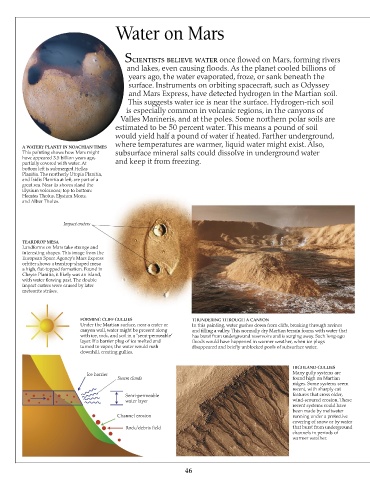
        A WATERY PLANET IN NOACHIAN TIMES
        This painting shows how Mars might   subsurface mineral salts could dissolve in underground water
        have appeared 3.5 billion years ago,
        partially covered with water. At   and keep it from freezing.
        bottom left is submerged Hellas
        Planitia. The northerly Utopia Planitia,
        and Isidis Planitia at left, are part of a
        great sea. Near its shores stand the
        Elysium volcanoes; top to bottom:
        Hecates Tholus, Elysium Mons,
        and Albur Tholus.


                      Impact craters


        TEARDROP MESA
        Landforms on Mars take strange and
        interesting shapes. This image from the
        European Space Agency's Mars Express
        orbiter shows a teardrop-shaped mesa—
        a high, flat-topped formation. Found in
        Chryse Planitia, it likely was an island,
        with water flowing past. The double
        impact craters were caused by later
        meteorite strikes.


                            FORMING CLIFF GULLIES                THUNDERING THROUGH A CANYON
                            Under the Martian surface, near a crater or   In this painting, water gushes down from cliffs, breaking through ravines
                            canyon wall, water might be present along   and filling a valley. This normally dry Martian terrain foams with water that
                            with ice, rock, and soil in a “semi-permeable”   has burst from underground reservoirs and is surging away. Such long-ago
                            layer. If a barrier plug of ice melted and   floods would have happened in warmer weather, when ice plugs
                            turned to vapor, the water would rush   disappeared and briefly unblocked pools of subsurface water.
                            downhill, creating gullies.

                                                                                                  HIGHLAND GULLIES
                              Ice barrier                                                         Many gully systems are
                                        Steam clouds                                              found high on Martian
                                                                                                  ridges. Some systems seem
                                                                                                  recent, with sharply cut
                                           Semi-permeable                                         features that cross older,
                                           water layer                                            wind-scoured erosion. These
                                                                                                  recent systems could have
                                                                                                  been made by meltwater
                                        Channel erosion                                           running under a protective
                                                                                                  covering of snow or by water
                                           Rock/debris field                                      that burst from underground
                                                                                                  channels in periods of
                                                                                                  warmer weather.


                                                              46

