


Page 52 - (DK) Eyewitness - Mars
P. 52
Is there life on Mars?


        Questions about Martian life began when
        early astronomers thought the planet was
        much like Earth. Later observers imagined
        they saw canals and vegetation in their
        telescopes. A few said Martians might be more
        advanced than humans. Then orbiters and
        robotic rovers found Mars to be a frozen desert
        with no living organisms. Scientists began to
        look for signs of past life, especially where                                        SPOTS ON POLAR ICE
        water once flowed. Their instruments                                                 These blotches on polar ice in
                                                                                             springtime are thought to be caused
        discovered ice, and their studies delved into                                        by frost withdrawing. A few
        Martian rocks on the planet and Martian                                              scientists, however, think certain of
                                                                                             these patterns could be caused by
        meteorites on Earth. Since microscopic life-                                         living microorganisms that change
                                                                                             their forms with warmer weather.
        forms exist in Earth’s most extreme regions, then                                    Bacteria living in Antarctic ice create
        microorganisms might also exist on Mars. The planet                                  similar patterns. On Mars some
                                                                                             patterns change even in places
        has “hot spots” that might be geothermal vents. These,                               where frost does not withdraw.
        some scientists say, may be among the best places to
        look for Martian life.


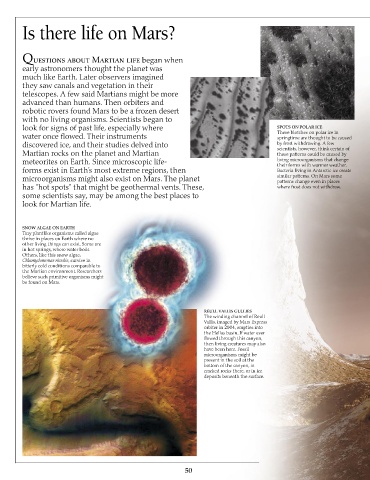
        SNOW ALGAE ON EARTH
        Tiny plantlike organisms called algae
        thrive in places on Earth where no
        other living things can exist. Some are
        in hot springs, where water boils.
        Others, like this snow algae,
        Chlamydomonas nivalis, survive in
        bitterly cold conditions comparable to
        the Martian environment. Researchers
        believe such primitive organisms might
        be found on Mars.


                                                                    REULL VALLIS GULLIES
                                                                    The winding channel of Reull
                                                                    Vallis, imaged by Mars Express
                                                                    orbiter in 2004, empties into
                                                                    the Hellas basin. If water ever
                                                                    flowed through this canyon,
                                                                    then living creatures may also
                                                                    have been here. Fossil
                                                                    microorganisms might be
                                                                    present in the soil at the
                                                                    bottom of the canyon, in
                                                                    cracked rocks there, or in ice
                                                                    deposits beneath the surface.


                                                              50

