


Page 44 - (DK) Eyewitness - Mars
P. 44
Dunes on Mars


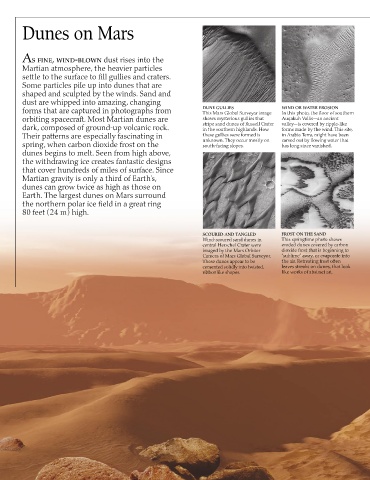
        As fine, wind-blown dust rises into the
        Martian atmosphere, the heavier particles
        settle to the surface to fill gullies and craters.
        Some particles pile up into dunes that are
        shaped and sculpted by the winds. Sand and
        dust are whipped into amazing, changing
        forms that are captured in photographs from                 DUNE GULLIES              WIND OR WATER EROSION
                                                                                              In this photo, the floor of southern
                                                                    This Mars Global Surveyor image
        orbiting spacecraft. Most Martian dunes are                 shows mysterious gullies that   Auqakuh Vallis—an ancient
        dark, composed of ground-up volcanic rock.                  stripe sand dunes of Russell Crater   valley—is covered by ripple-like
                                                                                              forms made by the wind. This site,
                                                                    in the southern highlands. How
        Their patterns are especially fascinating in                these gullies were formed is   in Arabia Terra, might have been
        spring, when carbon dioxide frost on the                    unknown. They occur mostly on   carved out by flowing water that
                                                                    south-facing slopes.
                                                                                              has long since vanished.
        dunes begins to melt. Seen from high above,
        the withdrawing ice creates fantastic designs
        that cover hundreds of miles of surface. Since
        Martian gravity is only a third of Earth’s,
        dunes can grow twice as high as those on
        Earth. The largest dunes on Mars surround
        the northern polar ice field in a great ring
        80 feet (24 m) high.


                                                                    SCOURED AND TANGLED       FROST ON THE SAND
                                                                    Wind-scoured sand dunes in   This springtime photo shows
                                                                    central Herschel Crater were   eroded dunes covered by carbon
                                                                    imaged by the Mars Orbiter   dioxide frost that is beginning to
                                                                    Camera of Mars Global Surveyor.   “sublime” away, or evaporate into
                                                                    These dunes appear to be   the air. Retreating frost often
                                                                    cemented solidly into twisted,   leaves streaks on dunes, that look
                                                                    ribbonlike shapes.        like works of abstract art.

