


Page 51 - (DK) Eyewitness - Mars
P. 51
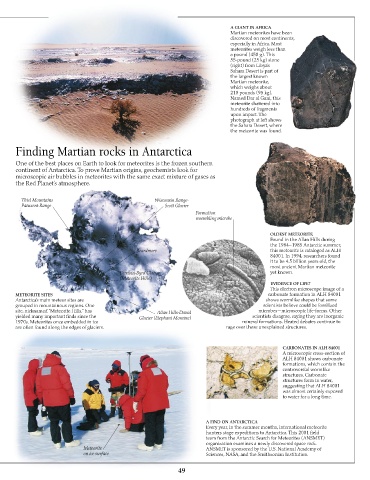
Meteorites from Mars                                                        A GIANT IN AFRICA
                                                                             Martian meteorites have been
                                                                             discovered on most continents,
                                                                             especially in Africa. Most
                                                                             meteorites weigh less than
                                                                             a pound (450 g). This
                                                                             55-pound (25 kg) stone
                                                                             (right) from Libya’s
                                                                             Sahara Desert is part of
                                                                             the largest known
                                                                             Martian meteorite,
                                                                             which weighs about
                                                                             210 pounds (95 kg).
                                                                             Named Dar al Gani, this
                                                                             meteorite shattered into
                                                                             hundreds of fragments
                                                                             upon impact. The
                                                                             photograph at left shows
                                                                             the Sahara Desert, where
                                                                             the meteorite was found.


      Finding Martian rocks in Antarctica

      One of the best places on Earth to look for meteorites is the frozen southern
      continent of Antarctica. To prove Martian origins, geochemists look for
      microscopic air bubbles in meteorites with the same exact mixture of gases as
      the Red Planet’s atmosphere.


        Thiel Mountains                             Wisconsin Range-
        Patuxent Range                                  Scott Glacier
                                                                  Formation
                                                                  resembling microbe


                                                                                          OLDEST METEORITE
                                                                                          Found in the Allan Hills during
                                                                                          the 1984–1985 Antarctic summer,
                                              Beardmore                                   this meteorite is cataloged as ALH
                                                                                          84001. In 1994, researchers found
                                                                                          it to be 4.5 billion years old, the
                                                                                          most ancient Martian meteorite
                                         Darwin-Byrd Glacier                              yet known.
                                         (Meteorite Hills)
                                                                                           EVIDENCE OF LIFE?
                                                                                          This electron microscope image of a
      METEORITE SITES                                                                     carbonate formation in ALH 84001
      Antarctica’s main meteor sites are                                                 shows wormlike shapes that some
      grouped in mountainous regions. One                                               scientists believe could be fossilized
      site, nicknamed “Meteorite Hills,” has         Allan Hills-David                 microbes—microscopic life-forms. Other
      yielded many important finds since the   Glacier (Elephant Moraine)            scientists disagree, saying they are inorganic
      1970s. Meteorites once embedded in ice                                     mineral formations. Heated debates continue to
      are often found along the edges of glaciers.                          rage over these unexplained structures.


                                                                                               CARBONATES IN ALH 84001
                                                                                               A microscopic cross-section of
                                                                                               ALH 84001 shows carbonate
                                                                                               formations, which contain the
                                                                                               controversial wormlike
                                                                                               structures. Carbonate
                                                                                               structures form in water,
                                                                                               suggesting that ALH 84001
                                                                                               was almost certainly exposed
                                                                                               to water for a long time.


                                                                     A FIND ON ANTARCTICA
                                                                     Every year, in the summer months, international meteorite
                                                                     hunters stage expeditions to Antarctica. This 2001 field
                                                                     team from the Antarctic Search for Meteorites (ANSMET)
                                                                     organization examines a newly discovered space rock.
                             Meteorite                               ANSMET is sponsored by the U.S. National Academy of
                             on ice surface                          Sciences, NASA, and the Smithsonian Institution.

                                                            49

