


Page 8 - (DK) Eyewitness - Mars
P. 8
Mars of the ancients


                                For thousands of years, astronomers had no telescopes. They had
                                only their eyes to observe stars and planets—the “heavenly bodies.” Ancient
                                scientists came to know six planets: Mercury, Venus, Earth, Mars, Jupiter,
                                and Saturn. Since they moved past the “fixed” stars of the night sky, the
                                planets earned the name “wandering stars.” Four thousand years ago, the
        IN THE NIGHT SKY        Egyptians called Mars—which glows orange-red—Har Décher, the “Red One.”
        Mars, at right, is the
        second-brightest object in   Centuries later, Babylonians named it Nirgal, the “Star of Death.” By the 5th
        this photograph. Jupiter is   century bc, Romans had named the planet Mars, for their god of war. The
        the brightest. Planets reflect
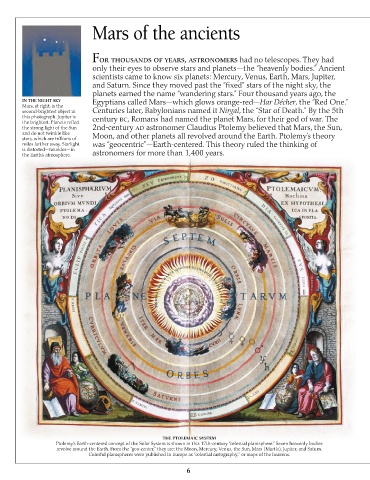
        the strong light of the Sun   2nd-century ad astronomer Claudius Ptolemy believed that Mars, the Sun,
        and do not twinkle like   Moon, and other planets all revolved around the Earth. Ptolemy’s theory
        stars, which are trillions of
        miles farther away. Starlight   was “geocentric”—Earth-centered. This theory ruled the thinking of
        is distorted—twinkles—in
        the Earth’s atmosphere.  astronomers for more than 1,400 years.


                                                       THE PTOLEMAIC SYSTEM
                    Ptolemy’s Earth-centered concept of the Solar System is shown in this 17th-century “celestial planisphere.” Seven heavenly bodies
                    revolve around the Earth. From the “geo-center,” they are: the Moon, Mercury, Venus, the Sun, Mars (Martis), Jupiter, and Saturn.
                              Colorful planispheres were published in Europe as “celestial cartography,” or maps of the heavens.

