


Page 12 - (DK) Eyewitness - Mars
P. 12
Mars and popular culture


        No other planet excites the imagination of Earthlings like Mars.
        In the late 19th century, writers began picturing what Martian
        “intelligent life” could be like. Usually, it seemed hostile. British
        novelist H. G. Wells first introduced spooky invaders from Mars in
        his 1897 War of the Worlds. Wells’s story was a best seller that sparked
        the public’s interest in fantastic Martian tales. Since the early movies
        of the 1920s, audiences have enjoyed Mars adventures that ranged
        from the creepy to the silly. One of the most terrifying was a 1938
        radio broadcast of War of the Worlds that sounded like an actual news
        report of a Martian invasion. From “Flash Gordon” radio programs to
        the latest feature films, vast audiences have been entertained by
        Mars in popular culture.                                                         THE MARTIAN CHRONICLES
                                                                                         Science fiction author Ray Bradbury
                                                                                         turned the tables with his 1951
                                                                                         Martian Chronicles, in which humans
                                                                                         invade Mars. There, humans are the
                                                                                         alien life-form. They are colonizers
                                                                                         who must build new homes in
                                                                                         completely strange surroundings.
                                                                        War of the Worlds

                                                                        Starting in 1897 with the chilling War of the Worlds
                                                                        by H. G. Wells, fiction shaped popular thinking about
                                                                       “Martians.” Radio dramatizations also appealed to
                                                                       audiences. In 1938, Orson Welles produced a radio
                                                                       version of War of the Worlds that created a sensation
                                                                      that would be remembered for generations to come.
                                                                      Stories like this continued to be popular in 21st-century
                                                                      fiction, radio, film, and television. The latest science
                                                                     fiction stories are rich in scientific and technical
                                                                     descriptions that appeal to modern readers.


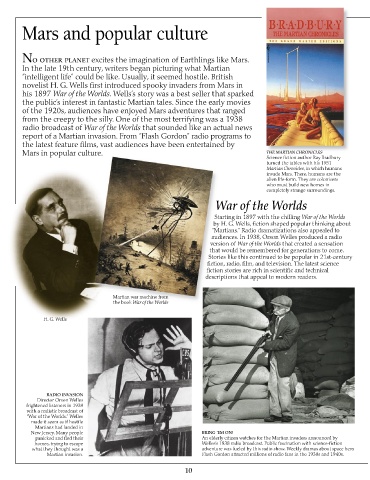
                                      Martian war machine from
                                      the book War of the Worlds

               H. G. Wells


                RADIO INVASION
             Director Orson Welles
          frightened listeners in 1938
          with a realistic broadcast of
          “War of the Worlds.” Welles
           made it seem as if hostile
             Martians had landed in
           New Jersey. Many people                                  BRING ‘EM ON!
             panicked and fled their                                An elderly citizen watches for the Martian invaders announced by
             homes, trying to escape                                Welles’s 1938 radio broadcast. Public fascination with science-fiction
            what they thought was a                                 adventure was fueled by this radio show. Weekly dramas about space hero
                 Martian invasion.                                  Flash Gordon attracted millions of radio fans in the 1930s and 1940s.

                                                              10

