


Page 11 - (DK) Eyewitness - Mars
P. 11
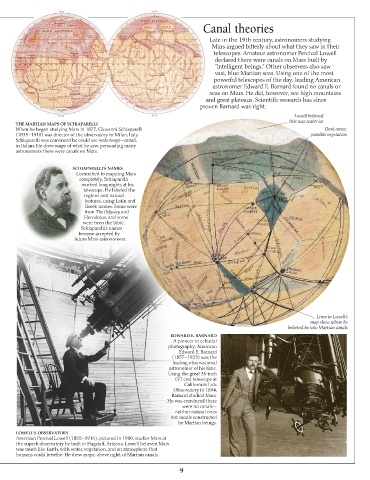
Canal theories


                                                                      Late in the 19th century, astronomers studying
                                                                       Mars argued bitterly about what they saw in their
                                                                        telescopes. Amateur astronomer Percival Lowell
                                                                        declared there were canals on Mars built by
                                                                        “intelligent beings.” Other observers also saw
                                                                        vast, blue Martian seas. Using one of the most
                                                                        powerful telescopes of the day, leading American
                                                                       astronomer Edward E. Barnard found no canals or
                                                                      seas on Mars. He did, however, see high mountains
                                                                     and great plateaus. Scientific research has since
                                                                   proven Barnard was right.
                                                                                                  Lowell believed
                                                                                                 this was water ice
      THE MARTIAN MAPS OF SCHIAPARELLI
      When he began studying Mars in 1877, Giovanni Schiaparelli                                            Dark areas:
      (1835–1910) was director of the observatory in Milan, Italy.                                      possible vegetation
      Schiaparelli was convinced he could see waterways—canali,
      in Italian. He drew maps of what he saw, persuading many
      astronomers there were canals on Mars.

                         SCHIAPARELLI’S NAMES
                          Committed to mapping Mars
                           completely, Schiaparelli
                            worked long nights at his
                             telescope. He labeled the
                             regions and natural
                             features, using Latin and
                             Greek names. Some were
                             from The Odyssey and
                             Herodotus, and some
                            were from the Bible.
                            Schiaparelli’s names
                           became accepted by
                          future Mars astronomers.


                                                                                                          Lines in Lowell’s
                                                                                                        map show where he
                                                                                                believed he saw Martian canals
                                                         EDWARD E. BARNARD
                                                          A pioneer in celestial
                                                         photography, American
                                                            Edward E. Barnard
                                                          (1857–1923) was the
                                                          leading observational
                                                         astronomer of his time.
                                                         Using the great 36-inch
                                                           (91 cm) telescope at
                                                              California’s Lick
                                                          Observatory in 1894,
                                                          Barnard studied Mars.
                                                        He was convinced there
                                                             were no canals—
                                                           neither natural ones
                                                         nor canals constructed
                                                            by Martian beings.
      LOWELL’S OBSERVATORY
      American Percival Lowell (1855–1916), pictured in 1900, studies Mars at
      the superb observatory he built in Flagstaff, Arizona. Lowell believed Mars
      was much like Earth, with water, vegetation, and an atmosphere that
      humans could breathe. He drew maps, above right, of Martian canals.

