


Page 10 - (DK) Eyewitness - Mars
P. 10
Astronomers focus on Mars


         The term astronomy combines the Greek astron, “star,” and
         nomos, “law.” Generally, astronomy is the study of planets and stars
         and the laws that govern their movements and dimensions. Early
         astronomers calculated the orbits of heavenly bodies by using
         mathematics, especially geometry. Poland’s Nicolaus Copernicus
         (1473–1543) led the way to understanding the “heliocentric”—
         “sun-centered”—theory of the Solar System. This broke with the
         geocentric system of Ptolemy, which placed the Earth at the                     NICOLAUS COPERNICUS
         center. Later astronomers confirmed Copernicus’s theory by using                This 16th-century Polish astronomer’s
                                                                                         theory that the planets revolve around
         the “perspicillum,” or “optick tube.” This magnifying device,                   the Sun won a growing following among
                                                                                         scientists. Leading astronomers such as
         renamed the telescope, came into use in the 1600s. By the 1800s,                Johannes Kepler accepted heliocentrism,
         scientists studied Mars with increasingly powerful telescopes, and              but many philosophers and religious
                                                                                         leaders did not. They believed in
         believed they saw canals and seas. Some                                         geocentrism well into the 1700s.
                       thought Mars might have age-
                           old civilizations that were                          HUYGENS AND THE HOURGLASS SEA
                             further advanced than                               Dutch astronomer Christiaan Huygens
                                                                                  (1629–1695) was one of those astronomers
                               those of Earth.                                    using ever-improving telescopes to study Mars.
                                                                                                    Huygens sketched
                                                                                                    pictures of a dark
                                 KEPLER’S ORBITAL MATH                                              smudge he noted on
                                 Johannes Kepler (1571–1630)                                        the planet. This was
                                 studied mathematics in his                                         named the Hourglass
                                 native Germany. He was                                             Sea because of its shape.
                                 also interested in astronomy.                                      Seen more clearly in
                                 By closely observing Mars,                                         improved telescopes
                                 Kepler discovered that the                                         two centuries later, it
                                 planets follow elliptical                                          would be renamed
                                orbits, not perfect circles.                                        Syrtis Major.
                               Using his knowledge of
                              mathematics, he calculated
                             the planets’ orbits. Kepler also
                            invented an improved telescope.                                           Framework for
                                                                                                      aiming telescope

         Pondering life

         on Mars

         As a young man William Herschel                                                                    Telescope tube
         (1738–1822) moved to England
         from his native Germany and
         taught music. Herschel was also a
         dedicated astronomer who built
         his own telescopes. He was
         especially captivated by Mars,
         which he thought was much like
         Earth. Huygens and Herschel were
         among the first to say Mars might
         have living beings.                       William Herschel


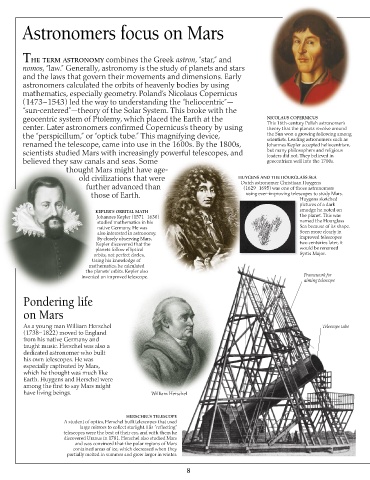
                                           HERSCHEL’S TELESCOPE
                      A student of optics, Herschel built telescopes that used
                           large mirrors to collect starlight. His “reflecting”
                      telescopes were the best of their era, and with them he
                      discovered Uranus in 1781. Herschel also studied Mars
                          and was convinced that the polar regions of Mars
                         contained areas of ice, which decreased when they
                       partially melted in summer and grew larger in winter.

