


Page 16 - World of Animals - Issue #30
P. 16
Cats: from tigers to tabbies


        The diversity


        of cats


        Whether big or small, all cats share
        a number of traits that shape them
        into graceful hunters

        The 36 species of wild cat all belong to the family
        known as Felidae. Over their millions of years on this
        planet, they have conquered every continent except
        Australasia and Antarctica.
          The rusty-spotted cat is the world’s smallest wild cat,
        weighing a mere 1.6 kilograms (3.5 pounds), while the
        biggest is the Siberian tiger at a hefty 300 kilograms
        (660 pounds). The diversity within the family is huge;
        cats are able to live in a wide range of habitats, from the
        snow leopard living high in the chilly mountains, to the
        jaguar living in the dense, humid jungle. Despite living
        in different parts of the world, all cat species share an
        incredible ability for hunting, which they are equipped
        for with retractable claws, long tails for balance, and
        low-slung bodies. Their eyes are perfectly adapted for
        low light, which helps them to stalk prey at dawn and
        dusk, while their muscular build gives them the power
        needed for a successful attack. The leopard is by far the
        strongest, able to carry prey twice its weight up a tree.
          While their hunting prowess is similar, vocal
        communication differs between species. Only the big
        cats from the pantherine lineage are able to roar, and
        a lion’s roar is so powerful it can be heard up to eight

        kilometres (five miles) away. But the ability to roar
        comes at a price. Lions, tigers, leopards, and jaguars
        have a length of tough cartilage in the neck preventing
        them from purring. No cat in the world can both roar
        and meow but no matter the species, cats mostly
        communicate using subtle body language.


                                                                                    Unique paws


                                                                                     The cheetah has its unusual paws to
                                                                                     thank for its success
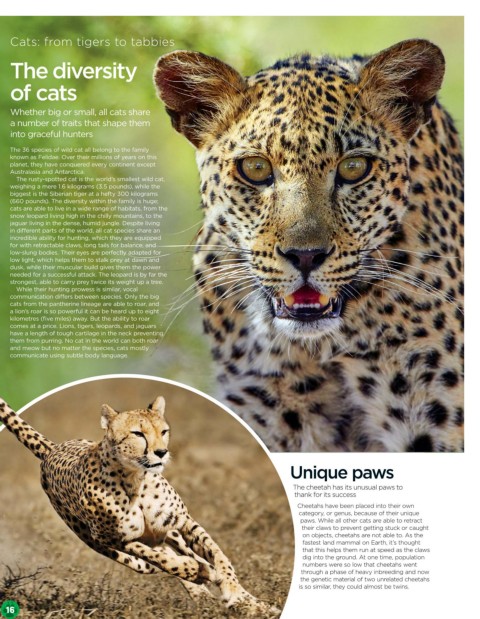
                                                                                      Cheetahs have been placed into their own
                                                                                      category, or genus, because of their unique
                                                                                       paws. While all other cats are able to retract
                                                                                       their claws to prevent getting stuck or caught
                                                                                       on objects, cheetahs are not able to. As the
                                                                                       fastest land mammal on Earth, it’s thought
                                                                                       that this helps them run at speed as the claws
                                                                                       dig into the ground. At one time, population
                                                                                       numbers were so low that cheetahs went
                                                                                       through a phase of heavy inbreeding and now
                                                                                       the genetic material of two unrelated cheetahs
                                                                                      is so similar, they could almost be twins.


       16


   012-020_Tigers_to tabbies.indd   16                                                                                   03/02/2016   14:17

