


Page 19 - World of Animals - Issue #30
P. 19
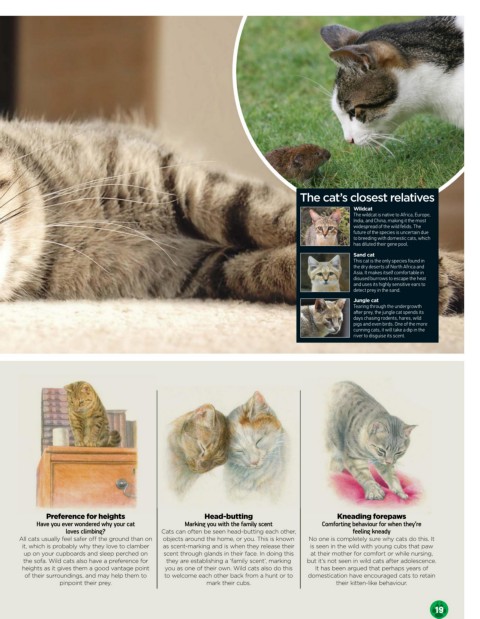
The cat’s closest relatives
                                                                                                     Wildcat
                                                                                                     The wildcat is native to Africa, Europe,
                                                                                                     India, and China, making it the most
                                                                                                     widespread of the wild felids. The
                                                                                                     future of the species is uncertain due
                                                                                                     to breeding with domestic cats, which
                                                                                                     has diluted their gene pool.
                                                                                                     Sand cat
                                                                                                     This cat is the only species found in
                                                                                                     the dry deserts of North Africa and
                                                                                                     Asia. It makes itself comfortable in
                                                                                                     disused burrows to escape the heat
                                                                                                     and uses its highly sensitive ears to
                                                                                                     detect prey in the sand.
                                                                                                     Jungle cat
                                                                                                     Tearing through the undergrowth

                                                                                                     aer prey, the jungle cat spends its
                                                                                                     days chasing rodents, hares, wild
                                                                                                     pigs and even birds. One of the more
                                                                                                     cunning cats, it will take a dip in the
                                                                                                     river to disguise its scent.


                                                                                                       i
                                                                                                        ng
                                                                                                                a
                                                                                                                 w
                                                                                                                   s
                                                                                                             ep
                                                                                                           f
                                                                                                           o
                                                                                                             r
                                                                                                     ad
                  Preference for heights
                  P r e f e r e n c e f o r h e i g h t s    Head-butting                        Kneading forepaws
                                                                                                  n
                                                                                                   e
                                                                                                 K
               Have you ever wondered why your cat     Marking you with the family scent     Comforting behaviour for when they’re
                       loves climbing?           Cats can often be seen head-butting each other,     feeling kneady
          All cats usually feel safer off the ground than on   objects around the home, or you. This is known   No one is completely sure why cats do this. It
           it, which is probably why they love to clamber   as scent-marking and is when they release their   is seen in the wild with young cubs that paw
            up on your cupboards and sleep perched on   scent through glands in their face. In doing this   at their mother for comfort or while nursing,
           the sofa. Wild cats also have a preference for   they are establishing a ‘family scent’, marking   but it’s not seen in wild cats after adolescence.
           heights as it gives them a good vantage point   you as one of their own. Wild cats also do this   It has been argued that perhaps years of
            of their surroundings, and may help them to   to welcome each other back from a hunt or to   domestication have encouraged cats to retain
                     pinpoint their prey.                    mark their cubs.                    their kitten-like behaviour.
                                                                                                                           19
   012-020_Tigers_to tabbies.indd   19                                                                                   03/02/2016   15:03

