


Page 23 - World of Animals - Issue #30
P. 23
Lizards


          Slow worm                                                                                                   2

          This common legless                                                                       1
          lizard is no snake
          Many people who spot a slow worm
          will assume that it is a snake, and they                                                  4
          could be forgiven for doing so. This is in
          fact a legless lizard, and can be found in   SLOW WORM                                                     3
          gardens across Europe and some parts   Anguis fragilis
          of Africa and Asia. Slow worms have a   Class Reptilia
          handy ability to shed their tail when they                                         1. Biggest       3. Fastest
          are startled or attacked, and when this                                            Komodo dragon    Black spiny-tailed
          happens, a new tail will grow back in a                                            Weighing in at   iguana
          matter of weeks. Rather than laying eggs   Territory Christmas Island              165kg (360lb)    The world record
          like many other lizard species, female   Diet Slugs, snails, insects               and reaching     for the fastest
          slow worms actually give birth to around   Lifespan 20 years  The tail of the slow worm can   lengths of up to   lizard goes to the
                                             Adult weight 75g (2.6oz)
          eight live young per fertilisation. This   Conservation status  disconnect when it is threatened,   3m (10ft), these   black spiny-tailed
          follows a courtship, initiated by a male                   in a process called caudal   huge lizards are   iguana, which can
          biting a female’s neck. A slow worm                        autonomy. Once shed, the tail   worthy of their   reach 34.9km/h
                                                                     wriggles for several minutes,
          takes around eight years to reach its full   NOT EVALUATED  creating the perfect distraction to   dragon names.  (21.7mph).
          adult length.                                              keep confused predators away.
                                                                                             2. Smallest      4. Most
          Horned toad                                                 HORNED TOAD            Dwarf gecko      venomous
                                                                                                              Gila monster
                                                                                             The dwarf gecko
          Not a frog but a misnamed lizard                            Phrynosoma hernandesi  measures a       One of just two
                                                                      Class Reptilia
          This lizard is widely known as a horned toad, but is also referred to by its       miniscule 16mm   venomous lizard
                                                                                             (0.6in) in length.
                                                                                                              species, the Gila
          more accurate name of ‘short-horned lizard’. Horned toads get their name           It lives in just two   monster bites
          from having squat bodies and short snouts, which are unlike the slender            remote locations   quickly and takes
          and slinky bodies of most lizard species. They are found across North   Territory North and Central   in the Caribbean   hold, delivering
          and Central America, and use their spikes as defences against their many   America  islands and was   the venom via
          predators, which include hawks, snakes, dogs and wolves. Their horns aren’t   Diet Ants, grasshoppers,   only discovered  grooved teeth on
          their only defence though – when attacked, they will inflate their bodies to   spiders  in 2001.     its lower jaw.

                                                                      Lifespan Unknown
          twice their original size to look more alarming, and if that still doesn’t work,   Adult weight 5g (0.18oz)
          they have a sinister ability to squirt blood from their eyes. Horned toads   Conservation status
          can be yellow, grey or red in colour, depending upon their habitat.                  A salamander
           Squirting blood at predators is not only meant to          LEAST CONCERN
           intimidate. The liquid also contains a chemical                                     is not a lizard
           that is harmful to dogs, wolves and coyotes. It

           can travel up to 1m (3) towards a target.
                                                                                               Salamanders and lizards have much in
                                                                                               common (including slender and smooth bodies
                                                                                               across many species), but they also have

                                                                                               plenty of differences. Most important of these
                                                                                               is that salamanders are amphibious, whereas
                                                                                               lizards are reptiles. Salamander bodies are
                                                                                               moist as they spend a lot of time in water and
                                                                                               damp places. They also don’t have scales,
                                                                                               while lizards do.
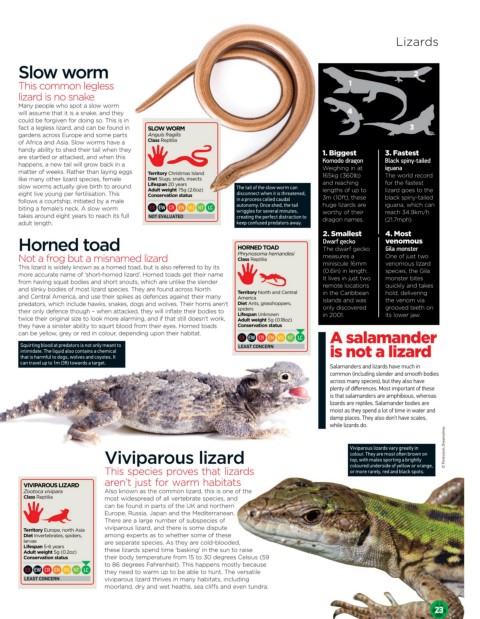
                                  Viviparous lizard                                                 Viviparous lizards vary greatly in   © Thinkstock; Dreamstime;

                                                                                                    colour. They are most oen brown on
                                                                                                    top, with males sporting a brightly
                                  This species proves that lizards                                  coloured underside of yellow or orange,
                                                                                                    or more rarely, red and black spots.
                                  aren’t just for warm habitats
           VIVIPAROUS LIZARD
           Zootoca vivipara       Also known as the common lizard, this is one of the
           Class Reptilia         most widespread of all vertebrate species, and
                                  can be found in parts of the UK and northern
                                  Europe, Russia, Japan and the Mediterranean.
                                  There are a large number of subspecies of
           Territory Europe, north Asia  viviparous lizard, and there is some dispute
           Diet Invertebrates, spiders,   among experts as to whether some of these
           larvae                 are separate species. As they are cold-blooded,
           Lifespan 5-6 years
           Adult weight 5g (0.2oz)  these lizards spend time ‘basking’ in the sun to raise
           Conservation status    their body temperature from 15 to 30 degrees Celsius (59
                                  to 86 degrees Fahrenheit). This happens mostly because
                                  they need to warm up to be able to hunt. The versatile
            LEAST CONCERN         viviparous lizard thrives in many habitats, including
                                  moorland, dry and wet heaths, sea cliffs and even tundra.


                                                                                                                           23


   022-023_Meet the family_Lizards.indd   23                                                                             03/02/2016   15:07

