


Page 26 - World of Animals - Issue #30
P. 26
Plains zebra


        Unbreakable bonds


        What influences a zebra’s everyday decisions

        Zebras live in permanent family groups and form strong bonds with
        those closest to them. Each unit is made up of a male, or stallion, up
        to six females and their young, all subject to a strict hierarchy. The
        stallion takes the top spot, foals are at the bottom of the heap and
        each female has her own rank in between, mostly determined by age.
        However, where a zebra is in her reproductive cycle can affect who
        is in charge of the group. Females that are producing milk to support
        babies need more energy than those without foals and have been
        observed taking the leading role in transit. The group typically travels
        in single file in a particular order; the dominant female leads the

        harem followed by her lower-ranking friends and the male guard
        walks behind. Zebra groups are vulnerable to predator attack and
        it is the stallion’s job to protect his family.
          Young male zebras live in bachelor groups after they leave
        their families. These rarely grow to more than 16 members,
        sometimes including older males that no longer live with
        a family. Zebras are extremely social and rely on being
        around others, so unattached males will stick together
        in any eventuality.
          These striped equids strengthen their family ties
        by grooming one another, and this mostly takes
        place between stallions and their favourite females
        or mothers and their favourite foals. The pair
        stand side by side and groom each other’s head,
        neck and back.
          Zebra families often come together during
        their annual migration journeys that can reach
        over 500 kilometres (300 miles) – the longest
        migration of any land mammal. This round
        trip spans several African countries
        and involves thousands of individuals
        searching for greener pastures. Such
        a long trip means the herd must
        get along. When males meet, they
        perform a polite greeting ritual where
        they sniff one another’s nostrils, bodies
        and tails, but females aren’t so cordial,
        and those from different harems can
        be aggressive towards each other.
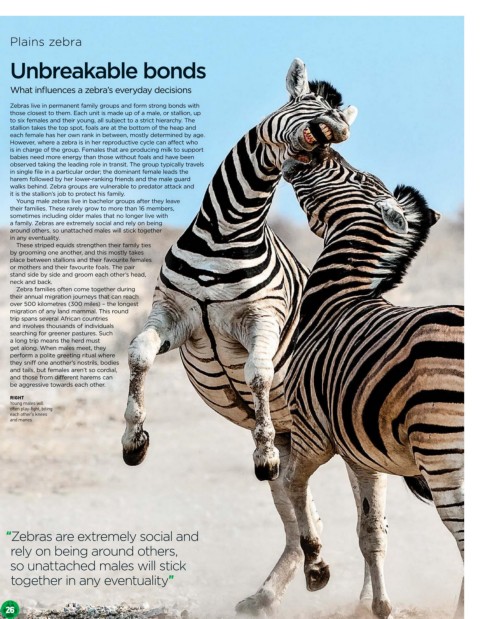
        RIGHT
        Young males will
        o en play-fi ght, biting

        each other’s knees
        and manes


       “Zebras are extremely social and

        rely on being around others,
        so unattached males will stick

        together in any eventuality”


       26


   024-033_AA_Common Zebra.indd   26                                                                                     03/02/2016   16:09

