


Page 32 - World of Animals - Issue #30
P. 32
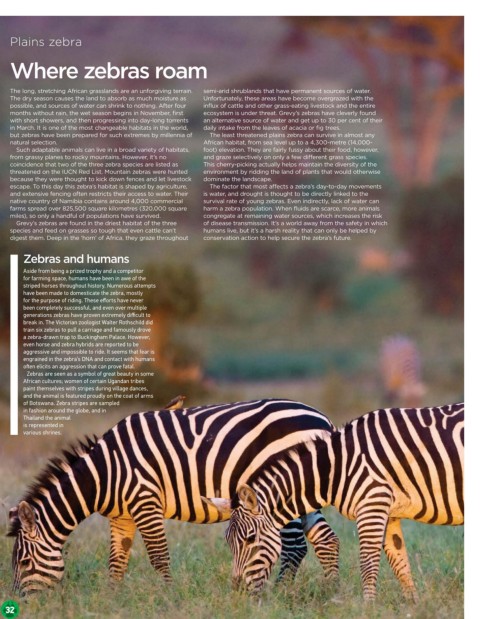
Plains zebra
Where zebras roam
The long, stretching African grasslands are an unforgiving terrain. semi-arid shrublands that have permanent sources of water.
The dry season causes the land to absorb as much moisture as Unfortunately, these areas have become overgrazed with the
possible, and sources of water can shrink to nothing. After four influx of cattle and other grass-eating livestock and the entire
months without rain, the wet season begins in November, first ecosystem is under threat. Grevy’s zebras have cleverly found
with short showers, and then progressing into day-long torrents an alternative source of water and get up to 30 per cent of their
in March. It is one of the most changeable habitats in the world, daily intake from the leaves of acacia or fig trees.
but zebras have been prepared for such extremes by millennia of The least threatened plains zebra can survive in almost any
natural selection. African habitat, from sea level up to a 4,300-metre (14,000-
Such adaptable animals can live in a broad variety of habitats, foot) elevation. They are fairly fussy about their food, however,
from grassy planes to rocky mountains. However, it’s no and graze selectively on only a few different grass species.
coincidence that two of the three zebra species are listed as This cherry-picking actually helps maintain the diversity of the
threatened on the IUCN Red List. Mountain zebras were hunted environment by ridding the land of plants that would otherwise
because they were thought to kick down fences and let livestock dominate the landscape.
escape. To this day this zebra’s habitat is shaped by agriculture, The factor that most affects a zebra’s day-to-day movements
and extensive fencing often restricts their access to water. Their is water, and drought is thought to be directly linked to the
native country of Namibia contains around 4,000 commercial survival rate of young zebras. Even indirectly, lack of water can
farms spread over 825,500 square kilometres (320,000 square harm a zebra population. When fluids are scarce, more animals
miles), so only a handful of populations have survived. congregate at remaining water sources, which increases the risk
Grevy’s zebras are found in the driest habitat of the three of disease transmission. It’s a world away from the safety in which
species and feed on grasses so tough that even cattle can’t humans live, but it’s a harsh reality that can only be helped by
digest them. Deep in the ‘horn’ of Africa, they graze throughout conservation action to help secure the zebra’s future.
Zebras and humans
Aside from being a prized trophy and a competitor
for farming space, humans have been in awe of the
striped horses throughout history. Numerous attempts
have been made to domesticate the zebra, mostly
for the purpose of riding. These efforts have never
been completely successful, and even over multiple
generations zebras have proven extremely difficult to
break in. The Victorian zoologist Walter Rothschild did
train six zebras to pull a carriage and famously drove
a zebra-drawn trap to Buckingham Palace. However,
even horse and zebra hybrids are reported to be
aggressive and impossible to ride. It seems that fear is
engrained in the zebra’s DNA and contact with humans
oen elicits an aggression that can prove fatal.
Zebras are seen as a symbol of great beauty in some
African cultures; women of certain Ugandan tribes
paint themselves with stripes during village dances,
and the animal is featured proudly on the coat of arms
of Botswana. Zebra stripes are sampled
in fashion around the globe, and in
Thailand the animal
is represented in
various shrines.
32
024-033_AA_Common Zebra.indd 32 03/02/2016 14:24

