


Page 33 - World of Animals - Issue #30
P. 33
Environmental factors Nearest
Africa’s herbivores navigate a threatened landscape neighbours
Agriculture Zebras are by no means the
Farmland requires space, food and
irrigation, and even just crops are only animal to make the African
damaging to the ecosystem. It’s a wilderness their home
difficult issue as indigenous people
rely on farming for their livelihood.
Settlement
A forecast published by the UN in
2015 estimates that the population
in Africa will have doubled by 2050.
This will create a huge demand for
housing and infrastructure.
Hunting
Whether it’s to prevent competition
with domestic animals or simply for
sport, zebras are oen hunted and
in several populations the damage
caused has been irreversible. Blue wildebeest
O en seen in herds alongside zebras,
Desertification wildebeest join in the mass migration
Without vegetation to hold the across the deadly Mara river. They live
ground together, topsoil can blow in small groups when on the move but
away and leave a dry, featureless rest in large herds.
desert. This happens if too many
animals feed on one patch of land.
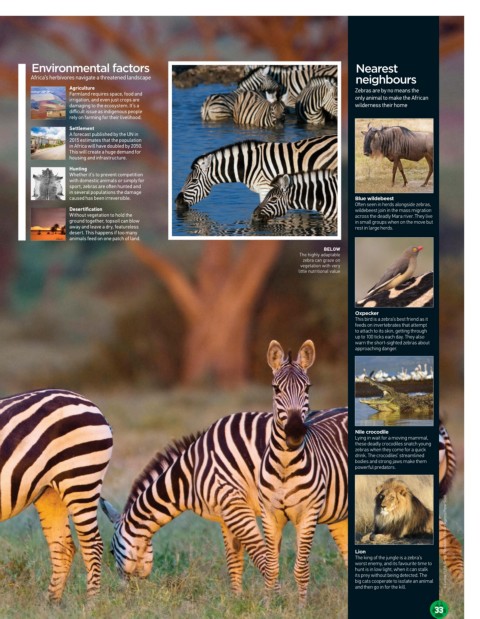
BELOW
The highly adaptable
zebra can graze on
vegetation with very
little nutritional value
Oxpecker
This bird is a zebra’s best friend as it
feeds on invertebrates that attempt
to attach to its skin, getting through
up to 100 ticks each day. They also
warn the short-sighted zebras about
approaching danger.
Nile crocodile
Lying in wait for a moving mammal,
these deadly crocodiles snatch young
zebras when they come for a quick
drink. The crocodiles’ streamlined
bodies and strong jaws make them
powerful predators.
© Corbis; FLPA; Getty; Thinkstock; The Art Agency/Peter Scott
Lion
The king of the jungle is a zebra’s
worst enemy, and its favourite time to
hunt is in low light, when it can stalk
its prey without being detected. The
big cats cooperate to isolate an animal
and then go in for the kill.
33
024-033_AA_Common Zebra.indd 33 03/02/2016 14:24

