


Page 68 - World of Animals - Issue #30
P. 68
Explore the Earth


         Spot six kinds of seal


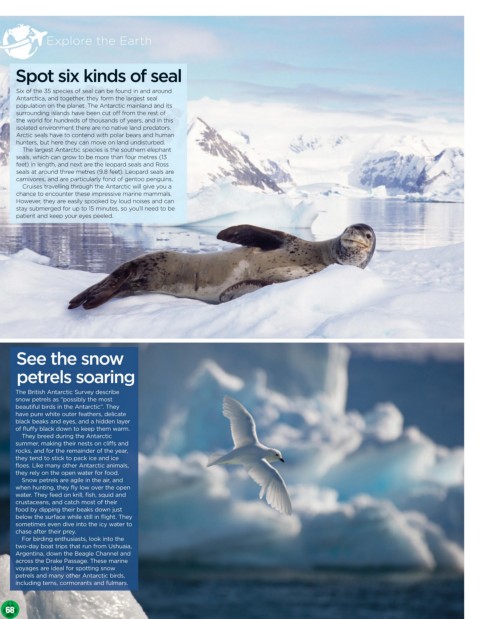
         Six of the 35 species of seal can be found in and around
         Antarctica, and together, they form the largest seal
         population on the planet. The Antarctic mainland and its
         surrounding islands have been cut off from the rest of
         the world for hundreds of thousands of years, and in this
         isolated environment there are no native land predators.
         Arctic seals have to contend with polar bears and human
         hunters, but here they can move on land undisturbed.
           The largest Antarctic species is the southern elephant
         seals, which can grow to be more than four metres (13
         feet) in length, and next are the leopard seals and Ross
         seals at around three metres (9.8 feet). Leopard seals are
         carnivores, and are particularly fond of gentoo penguins.
           Cruises travelling through the Antarctic will give you a
         chance to encounter these impressive marine mammals.
         However, they are easily spooked by loud noises and can
         stay submerged for up to 15 minutes, so you’ll need to be
         patient and keep your eyes peeled.


         See the snow


          petrels soaring

         The British Antarctic Survey describe
         snow petrels as “possibly the most
         beautiful birds in the Antarctic”. They
         have pure white outer feathers, delicate
         black beaks and eyes, and a hidden layer
         of fluffy black down to keep them warm.

           They breed during the Antarctic
         summer, making their nests on cliffs and
         rocks, and for the remainder of the year,
         they tend to stick to pack ice and ice
         floes. Like many other Antarctic animals,

         they rely on the open water for food.
           Snow petrels are agile in the air, and

         when hunting, they fly low over the open

         water. They feed on krill, fish, squid and
         crustaceans, and catch most of their
         food by dipping their beaks down just

         below the surface while still in flight. They
         sometimes even dive into the icy water to
         chase after their prey.
           For birding enthusiasts, look into the
         two-day boat trips that run from Ushuaia,
         Argentina, down the Beagle Channel and
         across the Drake Passage. These marine
         voyages are ideal for spotting snow
         petrels and many other Antarctic birds,
         including terns, cormorants and fulmars.


       68


   064-071_Antarctica.indd   68                                                                                          03/02/2016   16:12

