


Page 72 - World of Animals - Issue #30
P. 72
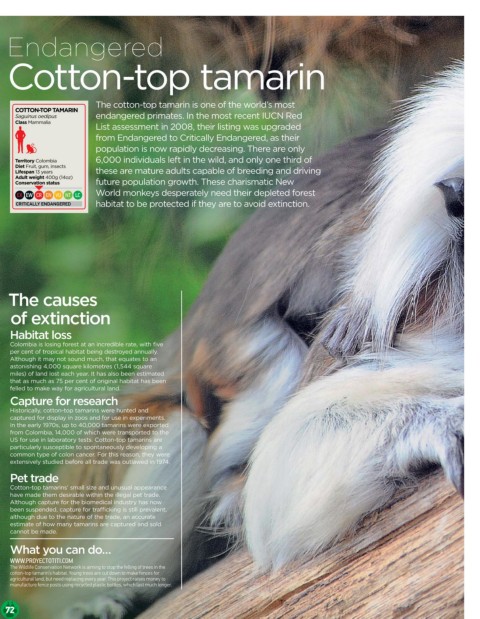
Endangered


       Cotton-top tamarin


                               The cotton-top tamarin is one of the world’s most
         COTTON-TOP TAMARIN
         Saguinus oedipus      endangered primates. In the most recent IUCN Red
         Class Mammalia
                               List assessment in 2008, their listing was upgraded
                               from Endangered to Critically Endangered, as their
                               population is now rapidly decreasing. There are only
         Territory Colombia    6,000 individuals left in the wild, and only one third of
         Diet Fruit, gum, insects
         Lifespan 13 years     these are mature adults capable of breeding and driving
         Adult weight 400g (14oz)
         Conservation status   future population growth. These charismatic New
                               World monkeys desperately need their depleted forest

         CRITICALLY ENDANGERED  habitat to be protected if they are to avoid extinction.


       The causes


        of extinction

        Habitat loss
        Colombia is losing forest at an incredible rate, with five

        per cent of tropical habitat being destroyed annually.
        Although it may not sound much, that equates to an
        astonishing 4,000 square kilometres (1,544 square
        miles) of land lost each year. It has also been estimated
        that as much as 75 per cent of original habitat has been
        felled to make way for agricultural land.
        Capture for research
        Historically, cotton-top tamarins were hunted and
        captured for display in zoos and for use in experiments.
        In the early 1970s, up to 40,000 tamarins were exported
        from Colombia, 14,000 of which were transported to the
        US for use in laboratory tests. Cotton-top tamarins are
        particularly susceptible to spontaneously developing a
        common type of colon cancer. For this reason, they were
        extensively studied before all trade was outlawed in 1974.

        Pet trade
        Cotton-top tamarins’ small size and unusual appearance
        have made them desirable within the illegal pet trade.
        Although capture for the biomedical industry has now
        been suspended, capture for trafficking is still prevalent,

        although due to the nature of the trade, an accurate
        estimate of how many tamarins are captured and sold
        cannot be made.

        What you can do…
        WWW.PROYECTOTITI.COM
        The Wildlife Conservation Network is aiming to stop the felling of trees in the
        cotton-top tamarin’s habitat. Young trees are cut down to make fences for
        agricultural land, but need replacing every year. This project raises money to
        manufacture fence posts using recycled plastic bottles, which last much longer.


       72


   072-073_Endangered_WOA30.indd   72                                                                                    03/02/2016   16:13

