


Page 69 - World of Animals - Issue #30
P. 69
Snap a scavenging skua                                                              Unusual Antarctic
                                                                                              inhabitants
          South polar skuas are the   petrels are known to fly high
          pirates of the bird world. Tough   over the land to avoid bumping
          and scrappy, they chase after   into them. Skuas are noisy
          other sea birds and harass them   during the breeding season,
          until they drop their fish. Snow   making high-pitched shrieks.


                                                                                              Toothfish
                                                                                              Toothfish live in some of the coldest waters on the
                                                                                              planet. Their bodies produce special proteins that
                                                                                              prevent their blood from freezing.


                                                                                              Krill
                                                                                              These tiny animals are one of the most important
                                                                                              species in the Antarctic food chain. They are eaten by
                                                                                              petrels, penguins, seals, whales and a whole host of
                                                                                              other species.


          Watch out for whales

                                                                                              Find the largest land animal
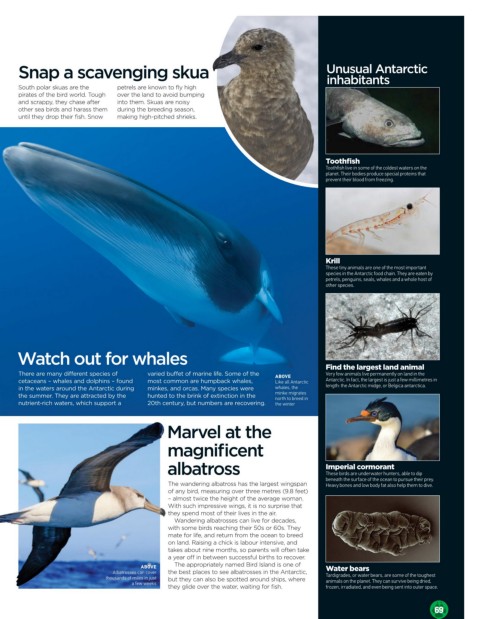
          There are many different species of   varied buffet of marine life. Some of the   ABOVE   Very few animals live permanently on land in the
          cetaceans – whales and dolphins – found   most common are humpback whales,   Like all Antarctic   Antarctic. In fact, the largest is just a few millimetres in
          in the waters around the Antarctic during   minkes, and orcas. Many species were   whales, the   length: the Antarctic midge, or Belgica antarctica.
          the summer. They are attracted by the   hunted to the brink of extinction in the   minke migrates
                                                                                north to breed in
          nutrient-rich waters, which support a   20th century, but numbers are recovering.  the winter

                                                   Marvel at the

                                                   magnificent

                                                   albatross                                  Imperial cormorant
                                                                                              These birds are underwater hunters, able to dip
                                                                                              beneath the surface of the ocean to pursue their prey.
                                                   The wandering albatross has the largest wingspan   Heavy bones and low body fat also help them to dive.
                                                   of any bird, measuring over three metres (9.8 feet)
                                                   – almost twice the height of the average woman.
                                                   With such impressive wings, it is no surprise that
                                                   they spend most of their lives in the air.
                                                     Wandering albatrosses can live for decades,
                                                   with some birds reaching their 50s or 60s. They
                                                   mate for life, and return from the ocean to breed
                                                   on land. Raising a chick is labour intensive, and
                                                   takes about nine months, so parents will often take
                                                   a year off in between successful births to recover.
                                           ABOVE     The appropriately named Bird Island is one of   Water bears
                                    Albatrosses can cover   the best places to see albatrosses in the Antarctic,
                                  thousands of miles in just   but they can also be spotted around ships, where   Tardigrades, or water bears, are some of the toughest
                                         a few weeks                                          animals on the planet. They can survive being dried,
                                                   they glide over the water, waiting for fish.  frozen, irradiated, and even being sent into outer space.

                                                                                                                           69


   064-071_Antarctica.indd   69                                                                                          03/02/2016   16:12

