


Page 73 - World of Animals - Issue #30
P. 73
Cotton-top tamarin


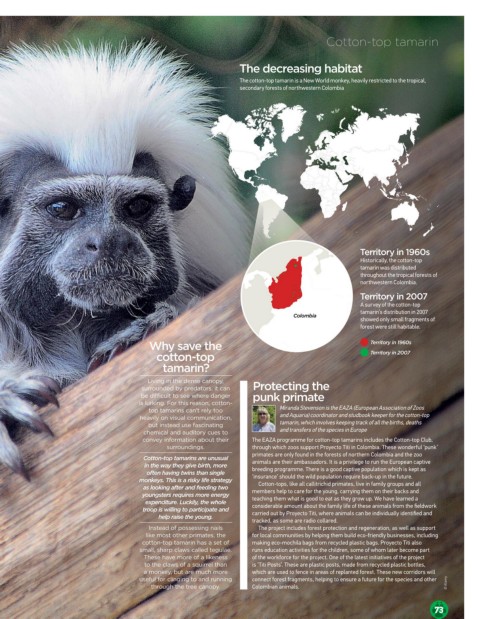
                                                                      The decreasing habitat
                                                                      The cotton-top tamarin is a New World monkey, heavily restricted to the tropical,
                                                                      secondary forests of northwestern Colombia


                                                                                                       Territory in 1960s
                                                                                                       Historically, the cotton-top
                                                                                                       tamarin was distributed
                                                                                                       throughout the tropical forests of
                                                                                                       northwestern Colombia.
                                                                                                       Territory in 2007
                                                                                                       A survey of the cotton-top
                                                                                                       tamarin’s distribution in 2007
                                                                                     Colombia
                                                                                                       showed only small fragments of
                                                                                                       forest were still habitable.
                                              Why save the                                                Territory in 1960s
                                                cotton-top                                                Territory in 2007
                                                 tamarin?

                                             Living in the dense canopy,
                                            surrounded by predators, it can   Protecting the
                                           be difficult to see where danger   punk primate

                                           is lurking. For this reason, cotton-
                                              top tamarins can’t rely too        Miranda Stevenson is the EAZA (European Association of Zoos
                                           heavily on visual communication,      and Aquaria) coordinator and studbook keeper for the cotton-top
                                             but instead use fascinating         tamarin, which involves keeping track of all the births, deaths
                                            chemical and auditory cues to        and transfers of the species in Europe
                                            convey information about their   The EAZA programme for cotton-top tamarins includes the Cotton-top Club,
                                                  surroundings.           through which zoos support Proyecto Titi in Colombia. These wonderful ‘punk’
                                                                           primates are only found in the forests of northern Colombia and the zoo
                                            Cotton-top tamarins are unusual
                                            in the way they give birth, more   animals are their ambassadors. It is a privilege to run the European captive
                                             often having twins than single   breeding programme. There is a good captive population which is kept as
                                           monkeys. This is a risky life strategy   ‘insurance’ should the wild population require back-up in the future.
                                            as looking after and feeding two   Cotton-tops, like all callitrichid primates, live in family groups and all
                                            youngsters requires more energy   members help to care for the young, carrying them on their backs and
                                             expenditure. Luckily, the whole   teaching them what is good to eat as they grow up. We have learned a

                                            troop is willing to participate and   considerable amount about the family life of these animals from the fieldwork

                                                help raise the young.     carried out by Proyecto Titi, where animals can be individually identified and
                                                                          tracked, as some are radio collared.
                                              Instead of possessing nails   The project includes forest protection and regeneration, as well as support
                                             like most other primates, the   for local communities by helping them build eco-friendly businesses, including
                                            cotton-top tamarin has a set of   making eco-mochila bags from recycled plastic bags. Proyecto Titi also
                                           small, sharp claws called tegulae.   runs education activities for the children, some of whom later become part
                                            These have more of a likeness   of the workforce for the project. One of the latest initiatives of the project
                                            to the claws of a squirrel than   is ‘Titi Posts’. These are plastic posts, made from recycled plastic bottles,
                                            a monkey, but are much more   which are used to fence in areas of replanted forest. These new corridors will
                                           useful for clinging to and running   connect forest fragments, helping to ensure a future for the species and other
                                              through the tree canopy.    Colombian animals.                                   © Alamy


                                                                                                                           73


   072-073_Endangered_WOA30.indd   73                                                                                    03/02/2016   16:58

