


Page 105 - (DK Eyewitness) Travel Guide - Ireland
P. 105
FUR THER AFIELD 103
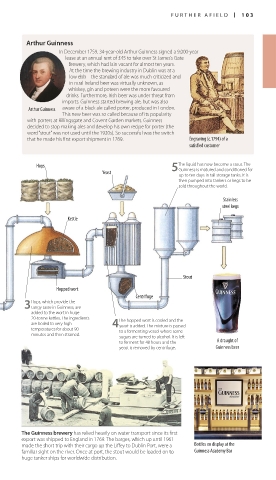
Arthur Guinness
In December 1759, 34-year-old Arthur Guinness signed a 9,000-year
lease at an annual rent of £45 to take over St James’s Gate
Brewery, which had lain vacant for almost ten years.
At the time the brewing industry in Dublin was at a
low ebb – the standard of ale was much criticized and
in rural Ireland beer was virtually unknown, as
whiskey, gin and poteen were the more favoured
drinks. Furthermore, Irish beer was under threat from
imports. Guinness started brewing ale, but was also
Arthur Guinness aware of a black ale called porter, produced in London.
This new beer was so called because of its popularity
with porters at Billingsgate and Covent Garden markets. Guinness
decided to stop making ales and develop his own recipe for porter (the
word “stout” was not used until the 1920s). So successful was the switch
that he made his first export shipment in 1769. Engraving (c.1794) of a
satisfied customer
The liquid has now become a stout. The
Hops 5Guinness is matured and conditioned for
Yeast
up to ten days in tall storage tanks. It is
then pumped into tankers or kegs to be
sold throughout the world.
Stainless
steel kegs
Kettle
Stout
Hopped wort
Centrifuge
Hops, which provide the
3tangy taste in Guinness, are
added to the wort in huge
20-tonne kettles. The ingred ients The hopped wort is cooled and the
are boiled to very high 4yeast is added. The mixture is passed
temperatures for about 90 to a fermenting vessel where some
minutes and then strained. sugars are turned to alcohol. It is left
to ferment for 48 hours and the A draught of
yeast is removed by centrifuge. Guinness beer
The Guinness brewery has relied heavily on water transport since its first
export was shipped to England in 1769. The barges, which up until 1961
made the short trip with their cargo up the Liffey to Dublin Port, were a Bottles on display at the
familiar sight on the river. Once at port, the stout would be loaded on to Guinness Academy Bar
huge tanker ships for worldwide distribution.
102-103_EW_Ireland.indd 103 08/03/17 11:05 am

