


Page 107 - (DK Eyewitness) Travel Guide - Ireland
P. 107
FUR THER AFIELD 105
commissioned by King William III 0 Glasnevin
in 1700, just ten years after Cemetery
victory at the Battle of the Boyne,
and was the largest barracks in Finglas Rd. Tel 882 6500. @ 13, 19,
his domain, with accommo 19A, 40, 40A from Parnell St.
dation for over 5,000 people. It Open 9am–6pm daily. 8 2:30pm
daily (lasts 90 minutes). Museum:
was in use right up to the 1990s. Tel 882 6550. Open 10am–5pm
After Irish independence the Mon–Fri, 11am–5pm Sat & Sun. &
barracks was named for Michael 0 = 7 ∑ glasnevinmuseum.ie
Collins, the first commanderin
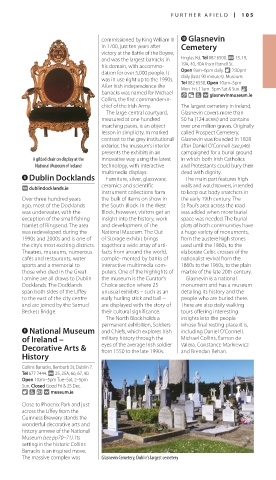
chief of the Irish Army. The largest cemetery in Ireland,
The large central courtyard, Glasnevin covers more than
measured at one hundred 50 ha (124 acres) and contains
marching paces, is an object over one million graves. Originally
lesson in simplicity. In marked called Prospect Cemetery,
contrast to the grey institutional Glasnevin was founded in 1828
exterior, the museum’s interior after Daniel O’Connell (see p46)
presents the exhibits in an campaigned for a burial ground
A gilded chair on display at the innovative way using the latest in which both Irish Catholics
National Museum of Ireland technology, with interactive and Protestants could bury their
multimedia displays. dead with dignity.
8 Dublin Docklands Furniture, silver, glassware, The main part features high
ceramics and scien tific walls and watchtowers, intended
∑ dublindocklands.ie
instrument collections form to keep out body snatchers in
Over three hundred years the bulk of items on show in the early 19th century. The
ago, most of the Docklands the South Block. In the West St Paul’s area across the road
was underwater, with the Block, however, visitors get an was added when more burial
exception of the small fishing insight into the history, work space was needed. The burial
hamlet of Ringsend. The area and development of the plots of both communities have
was redeveloped during the National Museum. The Out a huge variety of monuments,
1990s and 2000s and is one of of Storage exhibit brings from the austere high stones
the city’s most exciting districts. together a wide array of arti used until the 1860s, to the
Theatres, museums, numerous facts from around the world, elaborate Celtic crosses of the
cafés and restaurants, water comple mented by banks of nationalist revival from the
sports and a memorial to interactive multimedia com 1860s to the 1960s, to the plain
those who died in the Great puters. One of the highlights of marble of the late 20th century.
Famine are all draws to Dublin the museum is the Curator’s Glasnevin is a national
Docklands. The Docklands Choice section where 25 monument and has a museum
span both sides of the Liffey un usual exhibits – such as an detailing its history and the
to the east of the city centre early hurling stick and ball – people who are buried there.
and are joined by the Samuel are displayed with the story of There are also daily walking
Beckett Bridge. their cultural significance. tours offering interesting
The North Block holds a insights into the people
permanent exhibition, Soldiers whose final resting place it is,
9 National Museum and Chiefs, which explores Irish including Daniel O’Connell,
of Ireland – military history through the Michael Collins, Éamon de
Decorative Arts & eyes of the average Irish soldier Valera, Constance Markiewicz
and Brendan Behan.
from 1550 to the late 1990s.
History
Collins Barracks, Benburb St, Dublin 7.
Tel 677 7444. @ 25, 25A, 66, 67, 90.
Open 10am–5pm Tue–Sat, 2–5pm
Sun. Closed Good Fri & 25 Dec.
8 7 ^ ∑ museum.ie
Close to Phoenix Park and just
across the Liffey from the
Guinness Brewery stands the
wonderful decorative arts and
history annexe of the National
Museum (see pp70–71). Its
setting in the historic Collins
Barracks is an inspired move.
The massive complex was Glasnevin Cemetery, Dublin’s largest cemetery
104-105_EW_Ireland.indd 105 08/03/17 11:06 am

