


Page 247 - (DK Eyewitness) Travel Guide - Ireland
P. 247
THE MIDLANDS 245
a Norman building said to
mark the site of the first
monastery. The tiny church
nearby incorporates a
15th-century anchorite’s cell.
6 Kells
Road map D3. Co Meath. * 5,500.
@ n 046 924 8856. Open 9:30am–
5pm Mon–Fri. ∑ discover
ireland.ie/eastcoast
Signposted by its Irish name,
Ceanannus Mór, this modest
Authentic Victorian kitchen in Tullynally Castle town provides an unlikely
backdrop to the monastery for
Environs landscaped in the 1760s. The which it is so famous.
Just 10 km (6 miles) north of grounds include Victorian terraces, Kells Monastery was set up
Corlea Trackway, Ardagh is walled kitchen and flower by St Columba in the 6th
considered the most attractive gardens, two small lakes, a century, but its heyday came
village in Longford, with pretty Chinese and a Tibetan garden. after 806, when monks fled here
stone cottages gathered around from Iona. They may have been
a green. The River Shannon, the scribes who illuminated the
Lough Ree, River Inny and Lough 5 Fore Abbey superb Book of Kells, now kept
Gowna make Longford an Road map C3. Fore, Castle Pollard, at Trinity College, Dublin (see p68).
angler’s paradise. The “hot water” Co Westmeath. Tel 044 966 1780. The monastery centres on a
stretch at Lanesboro is famous @ to Castle Pollard. Open daily. rather gloomy 18th-century
for attracting coarse fish, and church beside which stands a
canoeists head for the white- The ruins of Fore Abbey lie in decapitated round tower. There
water rush at Ballymahon. glorious rolling countryside are several 9th-century High
about 8 km (5 miles) east of Crosses; the South Cross is in
Tullynally Castle. St Fechin set the best condition.
4 Tullynally Castle up a monastery here in 630, but Just north of the enclosure is
what you see now are the St Columba’s House, a tiny
Road map C3. Castle Pollard, Co
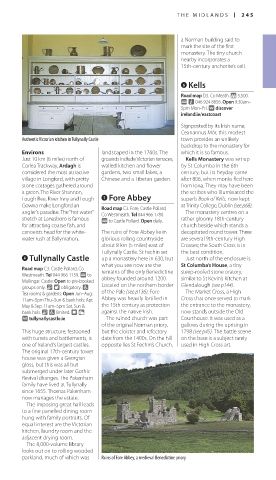
Westmeath. Tel 044 966 1159. @ to remains of the only Benedictine steep-roofed stone oratory,
Mullingar. Castle: Open to pre-booked abbey founded around 1200. similar to St Kevin’s Kitchen at
groups only. & 8 obligatory. 7 Located on the northern border Glendalough (see p144).
Tea rooms & gardens: Open Jun–Aug: of the Pale (see p136), Fore The Market Cross, a High
11am–5pm Thu–Sun & bank hols; Apr, Abbey was heavily fortified in Cross that once served to mark
May & Sep: 11am–5pm Sat, Sun & the 15th century as protection the entrance to the monastery,
bank hols. & 7 limited. - = against the native Irish. now stands outside the Old
∑ tullynallycastle.ie The ruined church was part Courthouse. It was used as a
of the original Norman priory, gallows during the uprising in
This huge structure, festooned but the cloister and refectory 1798 (see p45). The battle scene
with turrets and battlements, is date from the 1400s. On the hill on the base is a subject rarely
one of Ireland’s largest castles. opposite lies St Fechin’s Church, used in High Cross art.
The original 17th-century tower
house was given a Georgian
gloss, but this was all but
submerged under later Gothic
Revival changes. The Pakenham
family have lived at Tullynally
since 1655. Thomas Pakenham
now manages the estate.
The imposing great hall leads
to a fine panelled dining room
hung with family portraits. Of
equal interest are the Victorian
kitchen, laundry room and the
adjacent drying room.
The 8,000-volume library
looks out on to rolling wooded
parkland, much of which was Ruins of Fore Abbey, a medieval Benedictine priory
244-245_EW_Ireland.indd 245 08/03/17 11:07 am

