


Page 251 - (DK Eyewitness) Travel Guide - Ireland
P. 251
THE MIDLANDS 249
With monuments predating
Egypt’s pyramids, the Boyne
Valley is marketed as the Irish
“Valley of the Kings”.
Newgrange and Knowth can
only be seen on a tour run by
Brú na Bóinne Interpretative
Centre near Newgrange. The
centre has displays on the
area’s Stone Age heritage and a
reconstruction of Newgrange.
T Dowth
Off N51, 3 km (2 miles) E of
Newgrange. Closed to the public.
The passage grave at Dowth
was plundered by Victorian
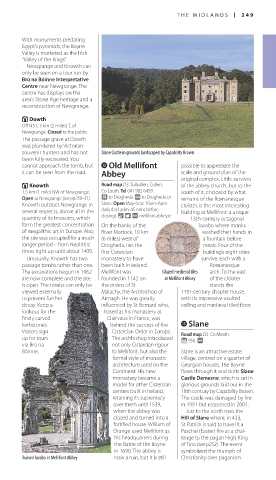
souvenir hunters and has not Slane Castle in grounds landscaped by Capability Brown
been fully excavated. You
cannot approach the tomb, but w Old Mellifont possible to appre ciate the
it can be seen from the road. Abbey scale and ground plan of the
original complex. Little survives
T Knowth Road map D3. Tullyallen, Cullen, of the abbey church, but to the
1.5 km (1 mile) NW of Newgrange. Co Louth. Tel 041 982 6459. south of it, enclosed by what
Open as Newgrange (see pp250–51). £ to Drogheda. @ to Drogheda or remains of the Roman esque
Knowth outdoes Newgrange in Slane. Open May–Sep: 10am–6pm cloister, is the most interesting
several respects, above all in the daily (last adm: 45 mins before build ing at Melli font: a unique
quantity of its treasures, which closing). & 8 ∑ mellifontabbey.ie 13thcentury octag onal
form the greatest con centration On the banks of the lavabo where monks
of megalithic art in Europe. Also, River Mattock, 10 km washed their hands in
the site was occupied for a much (6 miles) west of a foun tain before
longer period – from Neolithic Drogheda, lies the meals. Four of the
times right up until about 1400. first Cistercian building’s eight sides
Unusually, Knowth has two monastery to have survive, each with a
passage tombs rather than one. been built in Ireland. Romanesque
The excavations begun in 1962 Mellifont was Glazed medieval tiles arch. To the east
are now complete and the site founded in 1142 on at Mellifont Abbey of the cloister
is open. The tombs can only be the orders of St stands the
viewed externally Malachy, the Arch bishop of 14thcentury chapter house,
to prevent further Armagh. He was greatly with its impressive vaulted
decay. Keep a influenced by St Bernard who, ceiling and medieval tiled floor.
lookout for the based at his monastery at
finely carved Clairvaux in France, was
kerbstones. behind the success of the e Slane
Visitors sign Cistercian Order in Europe. Road map D3. Co Meath.
up for tours The archbishop introduced * 950. @
via Brú na not only Cistercian rigour
Bóinne. to Mellifont, but also the Slane is an attractive estate
formal style of monastic vill age, centred on a quartet of
architecture used on the Georgian houses. The Boyne
Continent. His new flows through it and skirts Slane
monastery be came a Castle Demesne, which is set in
model for other Cistercian glorious grounds laid out in the
centres built in Ireland, 18th century by Capability Brown.
retaining its supre macy The castle was damaged by fire
over them until 1539, in 1991 but reopened in 2001.
when the abbey was Just to the north rises the
closed and turned into a Hill of Slane where, in 433,
fortified house. William of St Patrick is said to have lit a
Orange used Melli font as Paschal (Easter) fire as a chal
his head quarters during lenge to the pagan High King
the Battle of the Boyne of Tara (see p252). The event
in 1690. The abbey is symbolized the triumph of
Ruined lavabo at Mellifont Abbey now a ruin, but it is still Christianity over paganism.
248-249_EW_Ireland.indd 249 08/03/17 11:07 am

