


Page 250 - (DK Eyewitness) Travel Guide - Ireland
P. 250
248 IRELAND REGION B Y REGION
0 Drogheda
Road map D3. Co Louth. * 30,000.
£ @ n Mayoralty St (041 983
7070). ( Sat. ∑ drogheda.ie
In the 12th century, this
Norman port near the mouth
of the River Boyne was one of
Ireland’s most important towns.
However, the place seems
never to have recovered from
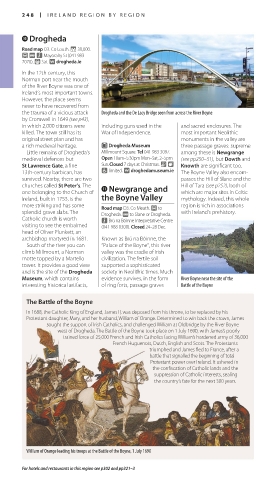
the trauma of a vicious attack Drogheda and the De Lacy Bridge seen from across the River Boyne
by Cromwell in 1649 (see p43),
in which 2,000 citizens were including guns used in the and sacred enclosures. The
killed. The town still has its War of Independence. most important Neolithic
original street plan and has monuments in the valley are
a rich medieval heritage. E Drogheda Museum three passage graves: supreme
Little remains of Drogheda’s Millmount Square. Tel 041 983 3097. among these is Newgrange
medieval defences but Open 10am–5:30pm Mon–Sat, 2–5pm (see pp250–51), but Dowth and
St Lawrence Gate, a fine Sun. Closed 7 days at Christmas. & 8 Knowth are significant too.
13thcentury barbican, has 7 limited. ∑ droghedamuseum.ie The Boyne Valley also encom
survived. Nearby, there are two passes the Hill of Slane and the
churches called St Peter’s. The q Newgrange and Hill of Tara (see p252), both of
one belonging to the Church of which are major sites in Celtic
Ireland, built in 1753, is the the Boyne Valley mythology. Indeed, this whole
more striking and has some Road map D3. Co Meath. £ to region is rich in associations
splendid grave slabs. The Drogheda. @ to Slane or Drogheda. with Ireland’s prehistory.
Catholic church is worth n Brú na Bóinne Interpretative Centre
visiting to see the embalmed (041 988 0300). Closed 24–28 Dec.
head of Oliver Plunkett, an
archbishop martyred in 1681. Known as Brú na Bóinne, the
South of the river you can “Palace of the Boyne”, this river
climb Millmount, a Norman valley was the cradle of Irish
motte topped by a Martello civilization. The fertile soil
tower. It provides a good view supported a sophisticated
and is the site of the Drogheda society in Neolithic times. Much
Museum, which contains evidence survives, in the form River Boyne near the site of the
interesting historical artifacts, of ring forts, passage graves Battle of the Boyne
The Battle of the Boyne
In 1688, the Catholic King of England, James II, was deposed from his throne, to be replaced by his
Protestant daughter, Mary, and her husband, William of Orange. Determined to win back the crown, James
sought the support of Irish Catholics, and challenged William at Oldbridge by the River Boyne
west of Drogheda. The Battle of the Boyne took place on 1 July 1690, with James’s poorly
trained force of 25,000 French and Irish Catholics facing William’s hardened army of 36,000
French Huguenots, Dutch, English and Scots. The Protestants
triumphed and James fled to France, after a
battle that signalled the beginning of total
Protestant power over Ireland. It ushered in
the confiscation of Catholic lands and the
suppression of Catholic interests, sealing
the country’s fate for the next 300 years.
William of Orange leading his troops at the Battle of the Boyne, 1 July 1690
For hotels and restaurants in this region see p302 and pp321–3
248-249_EW_Ireland.indd 248 08/03/17 11:07 am
Eyewitness Travel LAYERS PRINTED:
Catalogue template “UK” LAYER
(Source v2.1)
Date 5th December 2012
Size 125mm x 217mm

