


Page 252 - (DK Eyewitness) Travel Guide - Ireland
P. 252
250 IRELAND REGION B Y REGION
Newgrange
The origins of Newgrange, one of the most important passage
graves in Europe, are steeped in mystery. According to Celtic
lore, the legendary Kings of Tara (see p252) were buried here,
but Newgrange predates them. Built in around 3200 BC,
the grave was left untouched by all invaders until it was
rediscovered in 1699. When it was excavated in the 1960s,
archaeolo gists discovered that on the winter solstice
(21 December), rays of sun enter the tomb and light up
the burial chamber – making it the world’s oldest solar
observatory. All visitors to Newgrange and Knowth Basin Stone
(see pp248–9) are admitted through the visitors’ centre from The chiselled stones in each
recess would have contained
where tours of the historic site are taken. Long queues are funerary offerings and cremated
expected in summer and access is not always guaranteed. human remains.
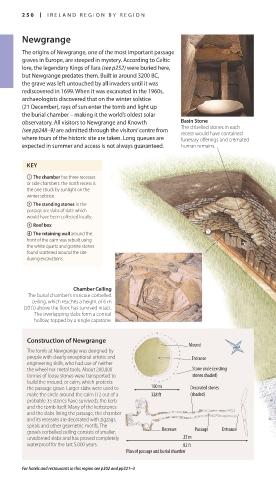
KEY
1 The chamber has three recesses
or side chambers: the north recess is
the one struck by sun light on the
winter solstice.
2 The standing stones in the
passage are slabs of slate which
would have been collected locally.
3 Roof box
4 The retaining wall around the
front of the cairn was rebuilt using
the white quartz and granite stones
found scattered around the site
during excavations.
Chamber Ceiling
The burial chamber’s intricate corbelled
ceiling, which reaches a height of 6 m
(20 ft) above the floor, has survived intact.
The overlapping slabs form a conical
hollow, topped by a single capstone.
Construction of Newgrange
Mound
The tomb at Newgrange was designed by
people with clearly exceptional artistic and Entrance
engineering skills, who had use of neither
the wheel nor metal tools. About 200,000 Stone circle (existing
tonnes of loose stones were transported to stones shaded)
build the mound, or cairn, which protects
the passage grave. Larger slabs were used to 100 m Decorated stones
make the circle around the cairn (12 out of a 328 ft (shaded)
probable 35 stones have survived), the kerb
and the tomb itself. Many of the kerbstones
and the slabs lining the passage, the chamber
and its recesses are decorated with zigzags,
spirals and other geometric motifs. The Recesses Passage Entrance
grave’s corbelled ceiling consists of smaller,
unadorned slabs and has proved completely 25 m
waterproof for the last 5,000 years. 82 ft
Plan of passage and burial chamber
For hotels and restaurants in this region see p302 and pp321–3
250-251_EW_Ireland.indd 250 08/03/17 11:07 am
Eyewitness Travel LAYERS PRINTED:
Starsight template “UK” LAYER
(Source v2.5)
Date 6th February2013
Size 125mm x 217mm

