


Page 41 - BBC Wildlife Volume 36 #11
P. 41
ONLINE

                                                                                                                                          BLUE
                                                                                                                                      PLANET II

                                                                                                                                    WATCH A CLIP FROM THE SERIES


                                                                In
                                                                focus


                                                                        High seas driter


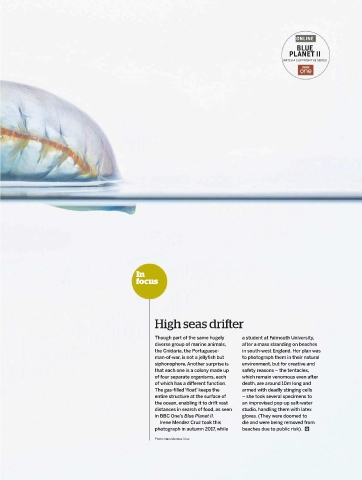
                                                                        Though part of the same hugely           a student at Falmouth University,
                                                                        diverse group of marine animals,         after a mass stranding on beaches
                                                                        the Cnidaria, the Portuguese-            in south-west England. Her plan was
                                                                        man-of-war, is not a jellyfish but        to photograph them in their natural
                                                                        siphonophore. Another surprise is        environment, but for creative and
                                                                        that each one is a colony made up        safety reasons – the tentacles,
                                                                        of four separate organisms, each         which remain venomous even after
                                                                        of which has a diferent function.        death, are around 10m long and
                                                                        The gas-filled ‘float’ keeps the           armed with deadly stinging cells
                                                                        entire structure at the surface of       – she took several specimens to
                                                                        the ocean, enabling it to drift vast     an improvised pop-up salt-water
                                                                        distances in search of food, as seen     studio, handling them with latex
                                                                        in BBC One’s Blue Planet II.             gloves. (They were doomed to
                                                                           Irene Mendez Cruz took this           die and were being removed from
                                                                        photograph in autumn 2017, while         beaches due to public risk).

                                                                        Photo:Irene Mendez Cruz

