


Page 43 - BBC Wildlife Volume 36 #11
P. 43
CHURCHYARD WILDLIFE


                                                                                           God’s


                                                                                           ACRE


                                                                                           Protected,undisturbedandoten


                                                                                           ancient,churchyardsarevaluable

                                                                                           refugesthatcanbewindowsinto

                                                                                           centuries-oldlandscapes.


                                                                                           By Stefan Buczacki


                                                    FROM BBC RADIO 4’S
                                                    LIVING WORLD SERIES
                                                                                                              sk anyone with more than
                                                                                                              a passing interest in our
                                                                                                              natural history to name
                                                                                                              the most significant places
                                                                                                              for the conservation of our
                                                                                                              country’s biodiversity, and
                                                                                          A the answers will probably
                                                                                           include wetlands, ancient woodlands, heaths,
                                                                                           unimproved grasslands – and possibly the
                                                                                           seashore and sand dunes. It is highly unlikely
                                                                                           they will include churchyards, yet for their
                                                                                           overall species richness and conservation
                                                                                           value these can rival almost anywhere.
                                                                                             Although most people will be familiar with
                                                                                           the location and size of their local churchyard,
                                                                                           whether in rural village or inner-city parish, it
                                                                                           is only when we realise the Church of England
                                                                                           alone has around 10,000 of them that their
                                                                                           potential as important habitats may begin to be
                                                                                           appreciated. Their total area has been reckoned
                                                                                           to approach that of a small national park, and to
                                                                                           this can be added the land occupied by the burial
                                                                                           grounds of other Christian denominations as
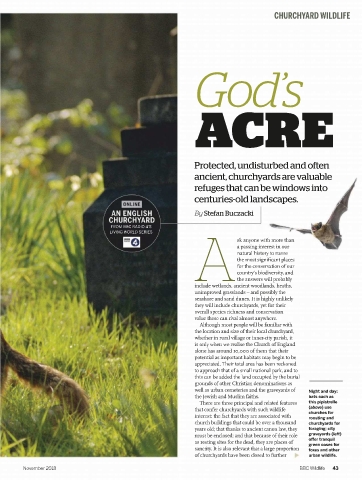
                                                                                           well as urban cemeteries and the graveyards of      Night and day:
                                                                                           the Jewish and Muslim faiths.                       bats such as
                                                                                             There are three principal and related features    this pipistrelle
                                                                                                                                               (above) use
                                                                                           that confer churchyards with such wildlife
                                                                                                                                               churches for
                                                                                           interest: the fact that they are associated with    roosting and
                                                                                           church buildings that could be over a thousand      churchyards for
                                                                                           years old; that thanks to ancient canon law, they   foraging; city
                                                                                           must be enclosed; and that because of their role    graveyards (left)
                                                                                                                                               ofer tranquil
                                                                                           as resting sites for the dead, they are places of
                                                                                                                                               green oases for
                                                                                           sanctity. It is also relevant that a large proportion   foxes and other
                                                                                           of churchyards have been closed to further          urban wildlife.


            November 2018                                                                                                                  BBC Wildlife   43

