


Page 46 - BBC Wildlife Volume 36 #11
P. 46
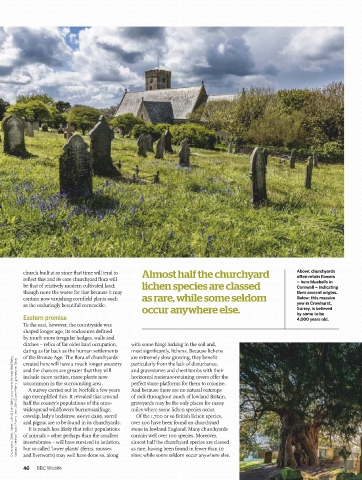
church built at or since that time will tend to       Almost half the churchyard                                              Above: churchyards
            reflect this and its core churchyard flora will                                                                                 often retain flowers
                                                                                                                                          – here bluebells in
            be that of relatively modern cultivated land;         lichen species are classed                                              Cornwall – indicating
            though none the worse for that because it may                                                                                 their ancient origins.
            contain now vanishing cornfield plants such            as rare, while some seldom                                              Below: this massive
            as the enduringly beautiful corncockle.                                                                                       yew in Crowhurst,
                                                                  occur anywhere else.                                                    Surrey, is believed

            Eastern promise                                                                                                               by some to be
                                                                                                                                          4,000 years old.
            To the east, however, the countryside was
            shaped longer ago, its enclosures defined
            by much more irregular hedges, walls and
            ditches – relics of far older land occupation,    with some fungi lurking in the soil and,
            dating as far back as the human settlements       most significantly, lichens. Because lichens
       Churchyard: Getty; lichen: John Glover/Getty; slow-worm: Kristian Bell/Getty;
            of the Bronze Age. The flora of churchyards        are extremely slow growing, they benefit
         waxcap: Matthew Taylor/Alamy; yew: John Glover/Alamy; gravestone: Getty
            created here will have a much longer ancestry     particularly from the lack of disturbance,
            and the chances are greater that they will        and gravestones and chest tombs with their
            include more rarities, more plants now            horizontal moisture-retaining covers offer the
            uncommon in the surrounding area.                 perfect stone platforms for them to colonise.
              A survey carried out in Norfolk a few years     And because there are no natural outcrops
            ago exemplified this. It revealed that around      of rock throughout much of lowland Britain,
            half the county’s populations of the once-        graveyards may be the only places for many
            widespread wildflowers burnet-saxifrage,           miles where some lichen species occur.
            cowslip, lady’s bedstraw, ox-eye daisy, sorrel      Of the 1,700 or so British lichen species,
            and pignut are to be found in its churchyards.    over 300 have been found on churchyard
              It is much less likely that relict populations   stone in lowland England. Many churchyards
            of animals – other perhaps than the smallest      contain well over 100 species. Moreover,
            invertebrates – will have survived in isolation,   almost half the churchyard species are classed
            but so called ‘lower plants’ (ferns, mosses       as rare, having been found in fewer than 10
            and liverworts) may well have done so, along      sites; while some seldom occur anywhere else.


            46    BBC Wildlife

