


Page 44 - BBC Wildlife Volume 36 #11
P. 44
CHURCHYARD WILDLIFE


            Life among the tombstones...


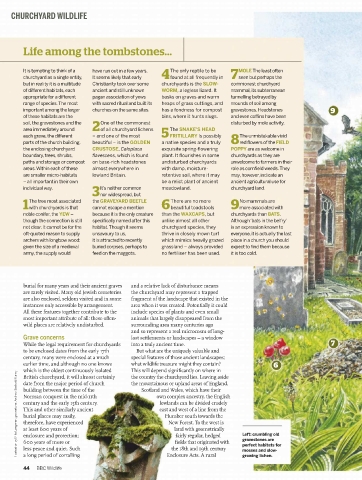
            It is tempting to think of a    have run out in a few years.        The only reptile to be         MOLE The least often
            churchyard as a single entity,   It seems likely that early     4  found at all frequently in  7  seen but perhaps the
            but in reality it is a multitude   Christianity took over some   churchyards is the SLOW-       commonest churchyard
            of diferent habitats, each      ancient and still unknown       WORM, a legless lizard. It      mammal, its subterranean
            appropriate for a diferent      pagan association of yews       basks on graves and warm        tunnelling betrayed by
            range of species. The most      with sacred ritual and built its   heaps of grass cuttings, and   mounds of soil among
            important among the larger      churches on the same sites.     has a fondness for compost      gravestones. Headstones                      9
            of these habitats are the                                       bins, where it hunts slugs.     and even co ns have been
            soil, the gravestones and the      One of the commonest                                         disturbed by mole activity.
            area immediately around         2 of all churchyard lichens        The SNAKE’S HEAD
            each grave, the diferent        – and one of the most           5  FRITILLARY is possibly           The unmistakable vivid
            parts of the church building,   beautiful – is the GOLDEN       a native species and a truly  8red flowers of the FIELD
            the enclosing churchyard        CRUSTOSE, Caloplaca             exquisite spring-flowering       POPPY are as welcome in
            boundary, trees, shrubs,        flavescens, which is found       plant. It flourishes in some     churchyards as they are
            paths and storage or compost    on base-rich headstones         undisturbed churchyards         unwelcome to farmers in their
            areas. Within each of these     almost everywhere in            with damp, moisture-            role as cornfield weeds. They
            are smaller micro-habitats      lowland Britain.                retentive soil, where it may    may, however, indicate an
            – all important in their own                                    be a relict plant of ancient    ancient agricultural use for
            individual way.                    It’s neither common          meadowland.                     churchyard land.
                                            3 nor widespread, but
              The tree most associated      the GRAVEYARD BEETLE                There are no more               No mammals are
            1with churchyards is that       cannot escape a mention         6 beautiful toadstools          9 more associated with
            noble conifer, the YEW –        because it is the only creature   than the WAXCAPS, but         churchyards than BATS.
            though the connection is still   specifically named after this   unlike almost all other         Although ‘bats in the belfry’
            not clear. It cannot be for the   habitat. Though it seems      churchyard species, they        is an expression known to
            oft-quoted reason to supply     unsavoury to us,                thrive in closely mown turf     everyone, it is actually the last
            archers with longbow wood:      it is attracted to recently     which mimics heavily grazed     place in a church you should
            given the size of a medieval    buried corpses, perhaps to      grassland – always provided     expect to find them because
            army, the supply would          feed on the maggots.            no fertiliser has been used.    it is too cold.


            burial for many years and their ancient graves    and a relative lack of disturbance means
            are rarely visited. Many old Jewish cemeteries    the churchyard may represent a trapped
            are also enclosed, seldom visited and in some     fragment of the landscape that existed in the
            instances only accessible by arrangement.         area when it was created. Potentially it could
            All these features together contribute to the     include species of plants and even small
            most important attribute of all: these often-     animals that largely disappeared from the
            wild places are relatively undisturbed.           surrounding area many centuries ago
                                                              and so represent a real microcosm of long-
            Grave concerns                                    lost settlements or landscapes – a window
            While the legal requirement for churchyards       into a truly ancient time.                                                                  7
            to be enclosed dates from the early 17th            But what are the uniquely valuable and
            century, many were enclosed at a much             special features of those ancient landscapes;
            earlier time, and although no one knows           what wildlife treasure might they contain?                       6
            which is the oldest continuously isolated         This will depend significantly on where in
         ustrat on by M ke Langman; gravestone: Andrew Baskott/A amy
            British churchyard, it will almost certainly      the country the churchyard lies. Leaving aside
            date from the major period of church              the mountainous or upland areas of England,
            building between the time of the                      Scotland and Wales, which have their
            Norman conquest in the mid-11th                              own complex ancestry, the English
            century and the early 15th century.                            lowlands can be divided crudely
            This and other similarly ancient                               east and west of a line from the
            burial places may easily,                                        Humber south towards the
            therefore, have experienced                                        New Forest. To the west is
            at least 600 years of                                                land with geometrically
            enclosure and protection;                                             fairly regular, hedged         Left: crumbling old
                                                                                                                 gravestones are
            600 years of more or                                                  fields that originated with
                                                                                                                 perfect habitats for
            less peace and quiet. Such                                          the 18th and 19th century        mosses and slow-
            a long period of corralling                                       Enclosure Acts. A rural
         I                                                                                                       growing lichen.

            44    BBC Wildlife

