


Page 60 - BBC Wildlife Volume 36 #11
P. 60
NEWS FEATURE


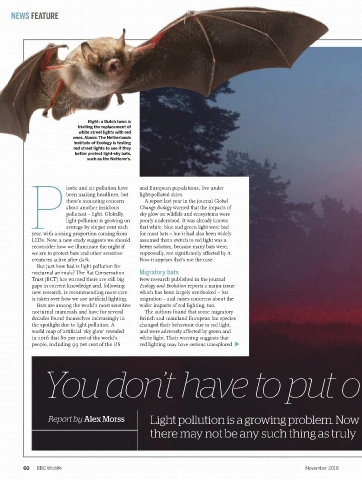
                                          Right: a Dutch town is
                                     trialling the replacement of
                                     white street lights with red
                                   ones. Above: The Netherlands
                                   Institute of Ecology is testing
                                   red street lights to see if they
                                    better protect light-shy bats,
                                         such as the Natterer’s.


                                lastic and air pollution have    and European populations, live under
                                been making headlines, but       light-polluted skies.
                                there’s mounting concern            A report last year in the journal Global
                                about another insidious          Change Biology warned that the impacts of
                                pollutant – light. Globally,     sky glow on wildlife and ecosystems were
                                light pollution is growing on    poorly understood. It was already known
               P average by six per cent each                    that white, blue and green light were bad
                year, with a rising proportion coming from       for most bats – but it had also been widely
                LEDs. Now, a new study suggests we should        assumed that a switch to red light was a
                reconsider how we illuminate the night if        better solution, because many bats were,
                we are to protect bats and other sensitive       supposedly, not significantly affected by it.
                creatures active after dark.                     Now it appears that’s not the case.
                  But just how bad is light pollution for
                nocturnal animals? The Bat Conservation          Migratory bats
                Trust (BCT) has warned there are still big       New research published in the journal
                gaps in current knowledge and, following         Ecology and Evolution reports a major issue
                new research, is recommending more care          which has been largely overlooked – bat
                is taken over how we use artificial lighting.     migration – and raises concerns about the
                  Bats are among the world’s most sensitive      wider impacts of red lighting, too.
                nocturnal mammals and have for several              The authors found that some migratory
                decades found themselves increasingly in         British and mainland European bat species
                the spotlight due to light pollution. A          changed their behaviour due to red light,
                world map of artificial ‘sky glow’ revealed       and were adversely affected by green and
                in 2016 that 80 per cent of the world’s          white light. Their warning suggests that
                people, including 99 per cent of the US          red lighting may have serious unexplored


                     You don’t have to put o


                       Report by Alex Morss                           Light pollution is a growing problem. Now


                                                                      there may not be any such thing as truly


            60    BBC Wildlife                                                                                                                November 2018

