


Page 62 - BBC Wildlife Volume 36 #11
P. 62
NEWS FEATURE


                  How does artiicial light afect other wildlife?


                                                     INVERTEBRATES                                                       BIRDS

                                                     Light pollution disturbs                                            Several species such as
                                                     feeding, breeding,                                                  robins and blackbirds sing
                                                     predation and movement.                                             under streetlights without
                                                     Up to one-third of moths                                            clear harm, but others – such
                                                     lured to night lights are                                           as long-eared owls and black-
                                                     estimated to die as a                                               tailed godwits – are sensitive
                                                     result. Egg-laying female                                           to artificial lighting. Bird
                                                     insects may be attracted                                            strikes on tall, lit buildings are
                                                     away from water.                                                    a major cause of mortality.


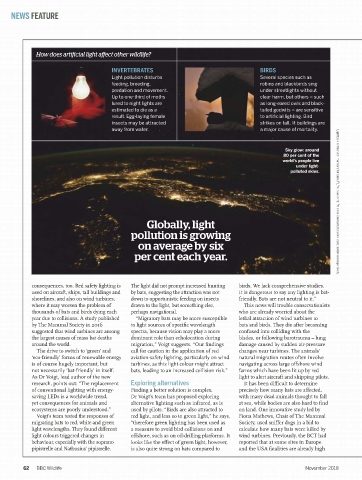
                                                                                                                                     Sky glow: around
                                                                                                                                    80 per cent of the
                                                                                                                                   world’s people live
                                                                                                                                          under light-
                                                                                                                                       polluted skies.


                                                                     Globally, light                                                                        Lightbulb: Mitsuhiko Imamori/Minden/FLPA; blackbird: Philippe Clement/naturepl.com; satellite image: Getty

                                                             pollution is growing


                                                                 on average by six

                                                               per cent each year.


                consequences, too. Red safety lighting is    The light did not prompt increased hunting        birds. We lack comprehensive studies.
                used on aircraft, ships, tall buildings and  by bats, suggesting the attraction was not        It is dangerous to say any lighting is bat-
                shorelines, and also on wind turbines,       down to opportunistic feeding on insects          friendly. Bats are not neutral to it.”
                where it may worsen the problem of           drawn to the light, but something else,              This news will trouble conservationists
                thousands of bats and birds dying each       perhaps navigational.                             who are already worried about the
                year due to collisions. A study published       “Migratory bats may be more susceptible        lethal attraction of wind turbines to
                by The Mammal Society in 2016                to light sources of specific wavelength            bats and birds. They die after becoming
                suggested that wind turbines are among       spectra, because vision may play a more           confused into colliding with the
                the largest causes of mass bat deaths        dominant role than echolocation during            blades, or following barotrauma – lung
                around the world.                            migration,” Voigt suggests. “Our findings          damage caused by sudden air-pressure
                  The drive to switch to ‘green’ and         call for caution in the application of red        changes near turbines. The animals’
                ‘eco-friendly’ forms of renewable energy     aviation-safety lighting, particularly on wind    natural migration routes often involve
                is of course hugely important, but           turbines, as this light colour might attract      navigating across large offshore wind
                not necessarily ‘bat-friendly’ in itself.    bats, leading to an increased collision risk.”    farms which have been lit up by red
                As Dr Voigt, lead author of the new                                                            light to alert aircraft and shipping pilots.
                research, points out: “The replacement       Exploring alternatives                               It has been difficult to determine
                of conventional lighting with energy-        Finding a better solution is complex.             precisely how many bats are affected,
                saving LEDs is a worldwide trend,            Dr Voigt’s team has proposed exploring            with many dead animals thought to fall
                yet consequences for animals and             alternative lighting such as infrared, as is      at sea, while bodies are also hard to find
                ecosystems are poorly understood.”           used by pilots. “Birds are also attracted to      on land. One innovative study led by
                  Voigt’s team tested the responses of       red light, and less so to green light,” he says,  Fiona Mathews, Chair of The Mammal
                migrating bats to red, white and green       “therefore green lighting has been used as        Society, used sniffer dogs in a bid to
                light wavelengths. They found different      a measure to avoid bird collisions on and         calculate how many bats were killed by
                light colours triggered changes in           offshore, such as on oil-drilling platforms. It   wind turbines. Previously, the BCT had
                behaviour, especially with the soprano       looks like the effect of green light, however,    reported that at some sites in Europe
                pipistrelle and Nathusius’ pipistrelle.      is also quite strong on bats compared to          and the USA fatalities are already high


            62    BBC Wildlife                                                                                                                November 2018

