


Page 63 - BBC Wildlife Volume 36 #11
P. 63
NEWS FEATURE


                enough to spark “serious concern for the      Lighting Professionals published ‘Bats and       focus on addressing LEDs. “This is an
                conservation of the species concerned”.       Artificial Lighting in the UK’, offering 25       important first step in raising awareness
                  Bats face worsening light pollution in      pages of guidance for lighting professionals,    of the problems with artificial lighting
                urban areas, too. In a 2014 report for the    designers, planning officers, developers,         and how to avoid or reduce them.” She
                BCT, Emma Stone of Bristol University         bat ecologists and anyone making decisions       points out that although people often see
                advised that lighting reduces the quantity,   about lighting.                                  bats hunting around street lights, this
                quality and connectivity of habitats bats       Jo Ferguson, Built Environment Officer at       behaviour is limited to a few of Britain’s
                use for foraging and roosting, including      the BCT, says the new guidance has a strong      fastest flying species. “Bats risk predation
                river corridors, woodland edges and                                                            by feeding this way,” she warns.
                hedgerows, creating barriers and delaying                                                         “Artificial lighting can interfere with
                the emergence of light-shy species who                                                         where and how bats roost, commute and
                miss peak feeding opportunities at dusk           Batsandlight                                 feed, which is why the Bat Conservation
             up/Getty  when insect prey is most abundant.         Which are afected?                           Trust prefers the term ‘reduced-impact’
                Stone estimates that almost a quarter of                                                       rather than ‘bat-friendly’ lighting.” Bat
             Re anzon/naturep .com; noctu e: Theo Douma/AGAMI/A amy; turb nes: Sean Ga
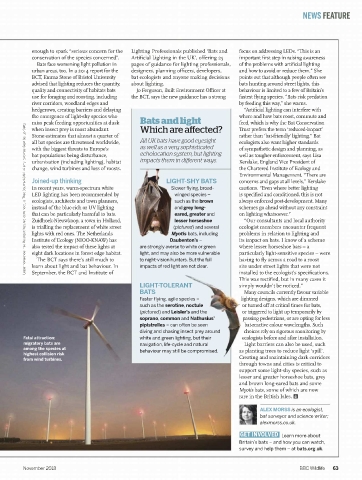
                all bat species are threatened worldwide,         All UK bats have good eyesight               ecologists also want higher standards
                with the biggest threats to Europe’s              as well as a very sophisticated              of sympathetic design and planning, as
                bat populations being disturbance,                echolocation system, but lighting            well as tougher enforcement, says Lisa
                urbanisation (including lighting), habitat        impacts them in diferent ways.               Kerslake, England Vice President of
                change, wind turbines and loss of roosts.                                                      the Chartered Institute of Ecology and
                                                                                                               Environmental Management. “There are
                Joined-up thinking                                            LIGHT-SHY BATS                   concerns and gaps at all levels,” Kerslake

                In recent years, warm-spectrum white                            Slower flying, broad-           cautions. “Even where better lighting
                LED lighting has been recommended by                              winged species –             is specified and conditioned, this is not
                ecologists, architects and town planners,                         such as the brown            always enforced post-development. Many
                instead of the blue-rich or UV lighting                           and grey long-               schemes go ahead without any constraint
                that can be particularly harmful to bats.                         eared, greater and           on lighting whatsoever.”
                Zuidhoek-Nieuwkoop, a town in Holland,                            lesser horseshoe                “Our consultants and local authority
                is trialling the replacement of white street                     (pictured) and several        ecologist members encounter frequent
                lights with red ones. The Netherlands                           Myotis bats, including         problems in relation to lighting and
                                                                               Daubenton’s –
                Institute of Ecology (NIOO-KNAW) has             are strongly averse to white or green         its impact on bats. I know of a scheme
             Lesser horseshoe: Inak  eight dark locations in forest edge habitat.  light, and may also be more vulnerable  particularly light-sensitive species – were
                also tested the impact of these lights at
                                                                                                               where lesser horseshoe bats – a
                  The BCT says there’s still much to
                                                                 to night-vision hunters. But the full
                                                                                                               having to fly across a road to a roost
                                                                                                               site under street lights that were not
                learn about light and bat behaviour. In
                                                                 impacts of red light are not clear.
                                                                                                               installed to the ecologist’s specifications.
                September, the BCT and Institute of
                                                                                                               This was rectified, but in many cases it
                                                                 LIGHT-TOLERANT                                simply wouldn’t be noticed.”
                                                                 BATS                                             Many councils currently favour variable
                                                                 Faster flying, agile species –                  lighting designs, which are dimmed
                                                                 such as the serotine, noctule                   or turned off at critical times for bats,
                                                                 (pictured) and Leisler’s and the                or triggered to light up temporarily by
                                                                 soprano, common and Nathusius’                  passing pedestrians, or are opting for less
                                                                 pipistrelles – can often be seen                 bat-reactive colour wavelengths. Such
                                                                 diving and chasing insect prey around            choices rely on rigorous monitoring by
            Fatal attraction:                                    white and green lighting, but their             ecologists before and after installation.
            migratory bats are                                   navigation, life-cycle and natural               Light barriers can also be used, such
            among the species at                                 behaviour may still be compromised.           as planting trees to reduce light ‘spill’.
            highest collision risk
            from wind turbines.                                                                                Creating and maintaining dark corridors
                                                                                                               through towns and cities is critical to
                                                                                                               support some light-shy species, such as
                                                                                                               lesser and greater horseshoe bats, grey
                                                                                                               and brown long-eared bats and some
                                                                                                               Myotis bats, some of which are now
                                                                                                               rare in the British Isles.

                                                                                                                         ALEX MORSS is an ecologist,
                                                                                                                         bat surveyor and science writer;
                                                                                                                         alexmorss.co.uk.


                                                                                                                GET INVOLVED Learn more about
                                                                                                               Britain’s bats – and how you can watch,
                                                                                                               survey and help them – at bats.org.uk.


            November 2018                                                                                                                  BBC Wildlife   63

