


Page 258 - (DK Eyewitness) Travel Guide - Italy
P. 258
256 CENTR AL IT AL Y
Understanding Architecture in Central Italy
Central Italy has countless fine Renaissance buildings,
many of them concentrated in and around Florence.
Their clear lines, elegant simplicity and harmonious
proportions came out of a re-evaluation of the past.
Turning their backs on the Gothic style, the architects
of the Renaissance returned to Classical Rome for
inspiration. Most of the large buildings had been
started by the late 15th century, paid for by the
Catholic Church or by powerful noble families,
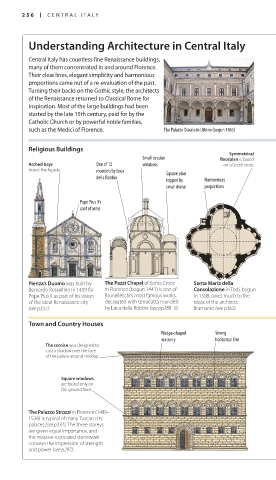
such as the Medici of Florence. The Palazzo Ducale in Urbino (begun 1465)
Religious Buildings
Symmetrical
Small circular floorplan is based
Arched bays One of 12 windows on a Greek cross.
trisect the façade. roundels by Luca Square plan
della Robbia topped by Harmonious
small dome proportions
Pope Pius II’s
coat of arms
Pienza’s Duomo was built by The Pazzi Chapel of Santa Croce Santa Maria della
Bernardo Rossellino in 1459 for in Florence (begun 1441) is one of Consolazione in Todi, begun
Pope Pius II as part of his vision Brunelleschi’s most famous works, in 1508, owes much to the
of the ideal Renaissance city decorated with terracotta roundels ideas of the architect
(see p337). by Luca della Robbia (see pp288–9). Bramante (see p363).
Town and Country Houses
Wedge-shaped Strong
masonry horizontal line
The cornice was designed to
cast a shadow over the face
of the palace around midday.
Square windows
are found only on
the ground floor.
The Palazzo Strozzi in Florence (1489–
1536) is typical of many Tuscan city
palaces (see p332). The three storeys
are given equal importance, and
the massive rusticated stonework
conveys the impression of strength
and power (see p297).
256-257_EW_Italy.indd 256 20/03/15 10:55 am
Eyewitness Travel LAYERS PRINTED:
Feature template “UK” LAYER
(SourceReport v1)
Date 24th July 2012
Size 125mm x 217mm

