


Page 261 - (DK Eyewitness) Travel Guide - Italy
P. 261
CENTR AL IT AL Y 259
EMILIA-ROMAGNA
Emilia-Romagna is the heartland of central Italy,
a broad corridor through the hills and plains of the
Po Valley that marks the watershed between the cold
north of the Alps and the hot Mediterranean south.
With its rich agricultural land, historic cities and thriving
industry, it is one of the most prosperous areas in Italy.
Most of the major towns in Emilia- medieval centres of
Romagna lie near the Via Aemilia, a Roman these towns. Cobbled
road built in 187 BC, which linked Rimini together from separate Papal
on the Adriatic coast with the garrison States in 1860, modern Emilia-Romagna
town of Piacenza. Prior to the Romans, was given its present borders in 1947.
the Etruscans had ruled from their capital, Emilia, the western part of the region,
Felsina, located on the site of present- is traditionally associated with a more
day Bologna. After the fall of Rome, the northern outlook and a tendency towards
region’s focus moved to Ravenna, which the left in politics. Romagna, on the other
became a principal part of the Byzantine hand, has witnessed an increase in the
Empire administered from Constantinople. support for right-wing parties calling
During the Middle Ages pilgrims for political independence from Rome.
heading for Rome continued to use the The entire region has a reputation as
Via Aemilia. Political power, however, a great gastronomic centre. Agriculture
passed to influential noble families – the has long thrived on the Po’s alluvial
Malatesta in Rimini, the Bentivoglio in fringes, earning the Pianura Padana (Po
Bologna, the d’Este in Ferrara and Modena, Plain) epithets such as the “breadbasket”
and the Farnese in Parma and Piacenza. and “fruit bowl” of Italy. Pigs still outnumber
Great courts grew up around the families, humans in many areas, and some of
attracting poets such as Dante and the country’s most famous staples –
Ariosto, as well as painters, sculptors and Parma ham and Parmesan cheese –
architects whose works still grace the originate here.
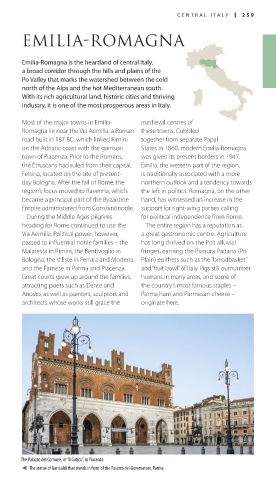
The Palazzo del Comune, or “il Gotico”, in Piacenza
The statue of Garibaldi that stands in front of the Palazzo del Governatore, Parma
258-259_EW_Italy.indd 259 4/4/17 5:34 PM

