


Page 259 - (DK Eyewitness) Travel Guide - Italy
P. 259
INTRODUCING CENTR AL IT AL Y 257
Understanding Architecture in Central Italy
Where to See the seeks to reinterpret it in his own
Architecture unique fashion. Urbino’s Palazzo
Ducale (pp374–5) perfects the
The simple canons of the Renais - grace and polish of the era and
sance were interpreted differently is a truly noble period residence.
away from the hotbed of artistic On a smaller scale are the planned
thought and cultural endeavour of Renaissance centres of elegant
Florence, which has the greatest towns such as Ferrara (pp264–5),
number of churches and palaces. Pienza (p337) and Urbania (p373).
Alberti’s Tempio Malatestiano at All three centres are examples of
Rimini (see p270) evokes the sobriety Vista in the Boboli enlightened patronage, and pay
of ancient Roman architecture yet Gardens, Florence homage to the art of antiquity.
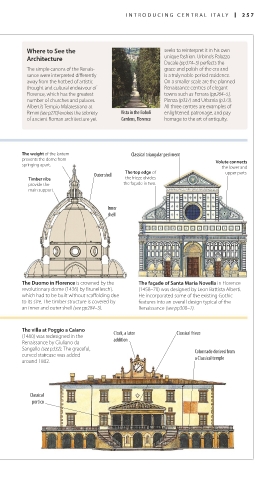
The weight of the lantern Classical triangular pediment
prevents the dome from Volute connects
springing apart.
the lower and
Outer shell The top edge of upper parts.
Timber ribs the frieze divides
provide the the façade in two.
main support.
Inner
shell
The Duomo in Florence is crowned by the The façade of Santa Maria Novella in Florence
revolutionary dome (1436) by Brunelleschi, (1458–70) was designed by Leon Battista Alberti.
which had to be built without scaffolding due He incorporated some of the existing Gothic
to its size. The timber structure is covered by features into an overall design typical of the
an inner and outer shell (see pp284–5). Renaissance (see pp300–1).
The villa at Poggio a Caiano Clock, a later Classical frieze
(1480) was redesigned in the
Renaissance by Giuliano da addition
Sangallo (see p332). The graceful, Colonnade derived from
curved staircase was added a Classical temple
around 1802.
Classical
portico
256-257_EW_Italy.indd 257 20/03/15 10:55 am

