


Page 289 - (DK Eyewitness) Travel Guide - Italy
P. 289
FL ORENCE 287
sculpture. Begun in 1255, eccentric bronze menagerie
the fortress-like building by Giambologna. To the
was initially the town right is the Salone del
hall (making it the Consiglio Generale,
oldest seat of a cavernous
government in former courtroom
the city), but it later that contains
became a prison the cream of the
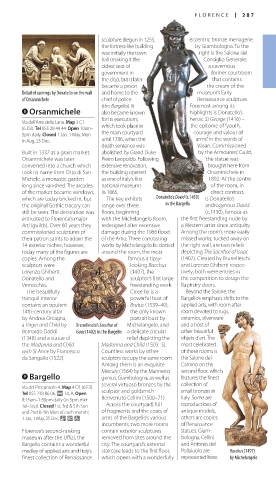
Detail of carvings by Donatello on the wall and home to the museum’s Early
of Orsanmichele chief of police Renaissance sculpture.
(the Bargello). It Foremost among its
8 Orsanmichele also became known highlights is Donatello’s
for its executions, heroic St George (1416) –
Via dell’Arte della Lana. Map 3 C1 the epitome of “youth,
(6 D3). Tel 055 28 49 44. Open 10am– which took place in
5pm daily. Closed 1 Jan, 1 May, Mon the main courtyard courage and valour of
in Aug, 25 Dec. until 1786, when the arms” in the words of
death sentence was Vasari. Commissioned
Built in 1337 as a grain market, abolished by Grand Duke by the Armourers’ Guild,
Orsanmichele was later Pietro Leopoldo. Following the statue was
converted into a church which extensive renovation, brought here from
took its name from Orto di San the building opened Orsanmichele in
Michele, a monastic garden as one of Italy’s first 1892. At the centre
long since vanished. The arcades national museums of the room, in
of the market became windows, in 1865. direct contrast,
which are today bricked in, but The key exhibits Donatello’s David (c.1430) is Donatello’s
the original Gothic tracery can range over three in the Bargello androgynous David
still be seen. The decoration was floors, beginning (c.1430), famous as
entrusted to Florence’s major with the Michelangelo Room, the first freestanding nude by
Arti (guilds). Over 60 years they redesigned after extensive a Western artist since antiquity.
commissioned sculptures of damage during the 1966 flood Among the room’s more easily
their patron saints to adorn the of the Arno. Three contrasting missed works, tucked away on
14 exterior niches; however, works by Michelangelo lie dotted the right wall, are two reliefs
today many of the figures are around the room, the most depicting The Sacrifice of Isaac
copies. Among the famous a tipsy- (1402). Created by Brunelleschi
sculptors were looking Bacchus and Lorenzo Ghiberti respec-
Lorenzo Ghiberti, (1497), the tively, both were entries in
Donatello and sculptor’s first large the competition to design the
Verrocchio. freestanding work. Baptistry doors.
The beautifully Close by is a Beyond the Salone, the
tranquil interior powerful bust of Bargello’s emphasis shifts to the
contains an opulent Brutus (1539–40), applied arts, with room after
14th-century altar the only known room devoted to rugs,
by Andrea Orcagna, portrait bust by ceramics, silverware
a Virgin and Child by Brunelleschi’s Sacrifice of Michelangelo, and and a host of
Bernardo Daddi Isaac (1402) in the Bargello a delicate circular other beautiful
(1348) and a statue of relief depicting the objets d’art. The
the Madonna and Child Madonna and Child (1503–5). most celebrated
with St Anne by Francesco Countless works by other of these rooms is
da Sangallo (1522). sculptors occupy the same room. the Salone del
Among them is an exquisite Camino on the
Mercury (1564) by the Mannerist second floor, which
9 Bargello genius, Giam bologna, as well as features the finest
several virtuoso bronzes by the collection of
Via del Proconsolo 4. Map 4 D1 (6 E3).
Tel 055 238 86 06. @ 14, A. Open sculptor and goldsmith small bronzes in
8:15am–1:30pm daily (to 5pm mid- Benvenuto Cellini (1500–71). Italy. Some are
Jul–Sep). Closed 1st, 3rd & 5th Sun Across the courtyard, full reproductions of
and 2nd & 4th Mon of each month; of fragments and the coats of antique models,
1 Jan, 1 May, 25 Dec. & ^ 7 arms of the Bargello’s various others are copies
incumbents, two more rooms of Renaissance
Florence’s second-ranking contain exterior sculptures statues. Giam-
museum after the Uffizi, the removed from sites around the bologna, Cellini
Bargello contains a wonderful city. The courtyard’s external and Antonio del
medley of applied arts and Italy’s staircase leads to the first floor, Pollaiuolo are Bacchus (1497)
finest collection of Renaissance which opens with a wonderfully represented here. by Michelangelo
286-287_EW_Italy.indd 287 4/4/17 5:35 PM

