


Page 292 - (DK Eyewitness) Travel Guide - Italy
P. 292
290 CENTR AL IT AL Y
e Uffizi
The Uffizi, Italy’s greatest art gallery, was built in 1560–80 to house Corridor ceilings are
offices (uffici) for Duke Cosimo I. The architect Vasari used iron as frescoed in the “grotesque”
reinforcement, enabling his successor, Buontalenti, to create an style of the 1580s, inspired
by Roman grottoes.
almost continuous wall of glass on the upper storey. This was
used as a gallery for Francesco I to display the Medici art treasures.
In the 19th century, the collection’s ancient objects were moved to Second
the archaeological museum and the sculpture to the Bargello, floor 1
leaving a priceless collection of paintings. Continuing renovations Main
may mean some room closures; check the website for details. Entrance
3
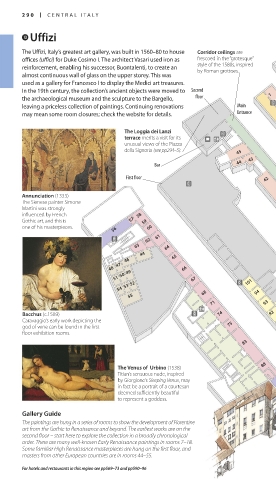
The Loggia dei Lanzi
terrace merits a visit for its
unusual views of the Piazza
della Signoria (see pp294–5). 45
43
Bar 44
First floor 42
Annunciation (1333)
The Sienese painter Simone
Martini was strongly
influenced by French 58 41
Gothic art, and this is 57 59
one of his masterpieces. 56 60
61
62 38
63 64
44
46 65
47
48 66
51 50 49 67
54 53 52 101
55 68 94
71 93 100 99
Bacchus (c.1589) 74 92 98
Caravaggio’s early work depicting the
god of wine can be found in the first 75 91
floor exhibition rooms.
83
The Venus of Urbino (1538) 88 89
Titian’s sensuous nude, inspired
by Giorgione’s Sleeping Venus, may
in fact be a portrait of a courtesan
deemed sufficiently beautiful
to represent a goddess.
Gallery Guide
The paintings are hung in a series of rooms to show the development of Florentine
art from the Gothic to Renaissance and beyond. The earliest works are on the
second floor – start here to explore the collection in a broadly chronological
order. There are many well-known Early Renaissance paintings in rooms 7–18.
Some familiar High Renaissance masterpieces are hung on the first floor, and
masters from other European countries are in rooms 44–55.
For hotels and restaurants in this region see pp569–73 and pp590–96
290-291_EW_Italy.indd 290 4/5/17 10:31 AM
Eyewitness Travel LAYERS PRINTED:
Starsight template “UK” LAYER
(Source v1.9)
Date 28th August 2012
Size 125mm x 217mm

