


Page 294 - (DK Eyewitness) Travel Guide - Italy
P. 294
292 CENTR AL IT AL Y
Exploring the Uffizi
The Uffizi offers not only the chance to see the world’s
greatest collection of Italian Renaissance paintings, but also
the opportunity to enjoy other European masterpieces from
Holland, Spain and Germany. Accumulated over the centuries
by the Medici, the collection was first housed in the Uffizi
in 1581, and eventually bequeathed to the Florentine people
by Anna Maria Ludovica, the last of the Medici.
Lorenzetti’s Presentation in
Gothic Art
the Temple (1342), in room 3,
Room 1 largely features also shows a concern for
paintings in the International threedimensional depth quite
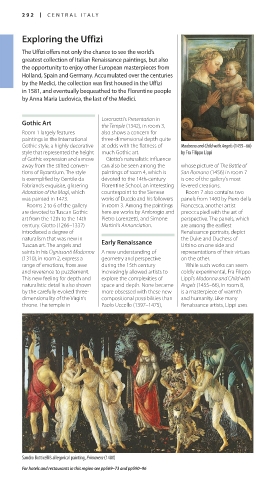
Gothic style, a highly decorative at odds with the flatness of Madonna and Child with Angels (1455–66)
style that represented the height much Gothic art. by Fra Filippo Lippi
of Gothic expression and a move Giotto’s naturalistic influence
away from the stilted conven can also be seen among the whose picture of The Battle of
tions of Byzantium. The style paintings of room 4, which is San Romano (1456) in room 7
is exemplified by Gentile da devoted to the 14thcentury is one of the gallery’s most
Fabriano’s exquisite, glittering Florentine School, an interesting fevered creations.
Adoration of the Magi, which counterpoint to the Sienese Room 7 also contains two
was painted in 1423. works of Duccio and his follow ers panels from 1460 by Piero della
Rooms 2 to 6 of the gallery in room 3. Among the paintings Francesca, another artist
are devoted to Tuscan Gothic here are works by Ambrogio and preoccupied with the art of
art from the 12th to the 14th Pietro Lorenzetti, and Simone perspective. The panels, which
century. Giotto (1266–1337) Martini’s Annunciation. are among the earliest
introduced a degree of Renaissance portraits, depict
naturalism that was new in the Duke and Duchess of
Tuscan art. The angels and Early Renaissance Urbino on one side and
saints in his Ognissanti Madonna A new understanding of representations of their virtues
(1310), in room 2, express a geometry and perspective on the other.
range of emotions, from awe during the 15th century While such works can seem
and reverence to puzzlement. increasingly allowed artists to coldly experimental, Fra Filippo
This new feeling for depth and explore the complexities of Lippi’s Madonna and Child with
naturalistic detail is also shown space and depth. None became Angels (1455–66), in room 8,
by the care fully evoked three more obsessed with these new is a masterpiece of warmth
dimensionality of the Virgin’s compositional possibilities than and humanity. Like many
throne. The temple in Paolo Uccello (1397–1475), Renaissance artists, Lippi uses
Sandro Botticelli’s allegorical painting, Primavera (1480)
For hotels and restaurants in this region see pp569–73 and pp590–96
292-293_EW_Italy.indd 292 26/04/16 5:16 pm
Eyewitness Travel LAYERS PRINTED:
Catalogue template “UK” LAYER
(Source v1.6)
Date 27th June 2012
Size 125mm x 217mm

