


Page 297 - (DK Eyewitness) Travel Guide - Italy
P. 297
FL ORENCE 295
t Palazzo Vecchio
Piazza della Signoria (entrance on
via della Ninna). Map 4 D1 (6 E4).
Tel 055 276 83 25. @ A, B. Open
Apr–Sep: 9am–11pm (to 2pm Thu);
Oct–Mar: 9am–7pm (to 2pm Thu).
Closed 1 Jan, Easter, 1 May, 15 Aug,
25 Dec. & 7 Secret Itineraries &
Children’s Museum tours (by
reservation only). Tel 055 276 83 25.
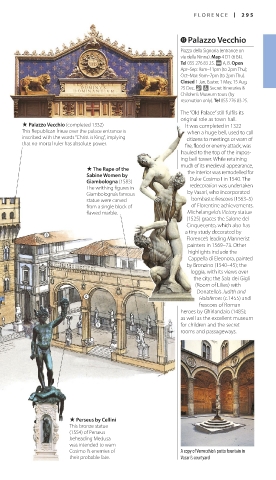
The “Old Palace” still fulfils its
original role as town hall.
. Palazzo Vecchio (completed 1332) It was completed in 1322
This Republican frieze over the palace entrance is when a huge bell, used to call
inscribed with the words “Christ is King”, implying citizens to meetings or warn of
that no mortal ruler has absolute power. fire, flood or enemy attack, was
hauled to the top of the impos-
ing bell tower. While retaining
much of its medieval appearance,
. The Rape of the the interior was remodelled for
Sabine Women by
Giambologna (1583) Duke Cosimo I in 1540. The
The writhing figures in redecoration was undertaken
Giambologna’s famous by Vasari, who incorporated
statue were carved bombastic frescoes (1563–5)
from a single block of of Florentine achievements.
flawed marble. Michel angelo’s Victory statue
(1525) graces the Salone dei
Cinquecento, which also has
a tiny study decorated by
Florence’s leading Mannerist
painters in 1569–73. Other
highlights include the
Cappella di Eleonora, painted
by Bronzino (1540–45); the
loggia, with its views over
the city; the Sala dei Gigli
(Room of Lilies) with
Donatello’s Judith and
Holofernes (c.1455) and
frescoes of Roman
heroes by Ghirlandaio (1485);
as well as the excellent museum
for children and the secret
rooms and passageways.
. Perseus by Cellini
This bronze statue
(1554) of Perseus
beheading Medusa
was intended to warn
Cosimo I’s enemies of A copy of Verrocchio’s putto fountain in
their probable fate. Vasari’s courtyard
294-295_EW_Italy.indd 295 26/04/16 5:17 pm

