


Page 295 - (DK Eyewitness) Travel Guide - Italy
P. 295
FL ORENCE 293
a religious subject to celebrate Rooms 19 to 23 depart from
earthly delights such as the gallery’s Florentine bias,
landscape and feminine beauty. demon strating how rapidly
A similar approach is apparent Renaissance ideas and
in the works of Botticelli, whose techniques spread beyond
famous paintings in rooms Tuscany. Painters from the
10–14 are for many the German and Flemish schools
highlight of the gallery. In The are well represented, together
Birth of Venus, for example, with painters from Umbria like
Venus takes the place of the Perugino, but perhaps the most
Virgin, expressing a fascination captivating works are the paint-
with Classical mythology ings by Venetian and northern
common to many Renaissance Italian artists such as Mantegna,
artists. The same is true of Carpaccio, Correggio and Bellini.
the Primavera (1480), which Room 35, which returns to
breaks with Christian religious the Tuscan mainstream, is
painting by illustrating a pagan dominated by Michelangelo’s
rite of spring. Holy Family, or Tondo Doni,
(1456), notable for its vibrant
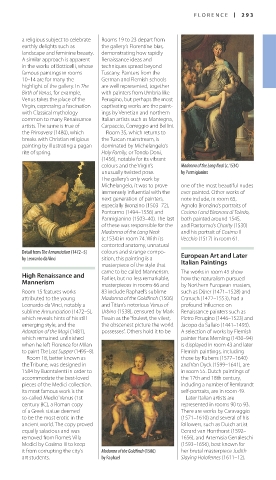
colours and the Virgin’s Madonna of the Long Neck (c.1534)
unusually twisted pose. by Parmigianino
The gallery’s only work by
Michelangelo, it was to prove one of the most beautiful nudes
immensely influential with the ever painted. Other works of
next generation of painters, note include, in room 65,
especially Bronzino (1503–72), Agnolo Bronzino’s portraits of
Pontormo (1494–1556) and Cosimo I and Eleonora di Toledo,
Parmigianino (1503–40). The last both painted around 1545,
of these was responsible for the and Pontormo’s Charity (1530)
Madonna of the Long Neck and his portrait of Cosimo il
(c.1534) in room 74. With its Vecchio (1517) in room 61.
contorted anatomy, unnatural
Detail from The Annunciation (1472–5) colours and strange compo-
by Leonardo da Vinci sition, this painting is a European Art and Later
Italian Paintings
masterpiece of the style that
came to be called Mannerism. The works in room 45 show
High Renaissance and Earlier, but no less remarkable, how the naturalism pursued
Mannerism masterpieces in rooms 66 and by Northern European masters,
Room 15 features works 83 include Raphael’s sublime such as Dürer (1471–1528) and
attributed to the young Madonna of the Goldfinch (1506) Cranach (1472–1553), had a
Leonardo da Vinci, notably a and Titian’s notorious Venus of profound influence on
sublime Annunciation (1472–5), Urbino (1538), censured by Mark Renaissance painters such as
which reveals hints of his still Twain as the “foulest, the vilest, Pietro Perugino (1446–1523) and
emerging style, and the the obscenest picture the world Jacopo da Sallaio (1441–1493).
Adoration of the Magi (1481), possesses”. Others hold it to be A selection of works by Flemish
which remained unfinished painter Hans Memling (1430–94)
when he left Florence for Milan is displayed in room 43 and later
to paint The Last Supper (1495–8). Flemish paintings, including
Room 18, better known as those by Rubens (1577–1640)
the Tribune, was designed in and Van Dyck (1599–1641), are
1584 by Buontalenti in order to in room 55. Dutch paintings of
accommodate the best-loved the 17th and 18th century,
pieces of the Medici collection. including a number of Rembrandt
Its most famous work is the self-portraits, are in room 49.
so-called Medici Venus (1st Later Italian artists are
century BC), a Roman copy represented in rooms 90 to 93.
of a Greek statue deemed There are works by Caravaggio
to be the most erotic in the (1571–1610) and several of his
ancient world. The copy proved followers, such as Dutch artist
equally salacious and was Gerard van Honthorst (1592–
removed from Rome’s Villa 1656), and Artemisia Gentileschi
Medici by Cosimo III to keep (1593–1656), best known for
it from corrupting the city’s Madonna of the Goldfinch (1506) her brutal masterpiece Judith
art students. by Raphael Slaying Holofernes (1611–12).
292-293_EW_Italy.indd 293 26/04/16 5:17 pm

