


Page 386 - (DK Eyewitness) Travel Guide - Italy
P. 386
384 ROME AND LAZIO
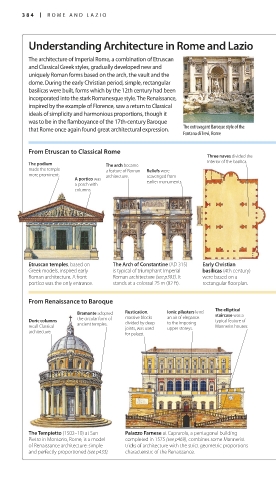
Understanding Architecture in Rome and Lazio
The architecture of Imperial Rome, a combination of Etruscan
and Classical Greek styles, gradually developed new and
uniquely Roman forms based on the arch, the vault and the
dome. During the early Christian period, simple, rectangular
basilicas were built, forms which by the 12th century had been
incorporated into the stark Romanesque style. The Renaissance,
inspired by the example of Florence, saw a return to Classical
ideals of simplicity and harmonious proportions, though it
was to be in the flamboyance of the 17th-century Baroque
that Rome once again found great architectural expression. The extravagant Baroque style of the
Fontana di Trevi, Rome
From Etruscan to Classical Rome
Three naves divided the
interior of the basilica.
The podium The arch became
made the temple a feature of Roman Reliefs were
more prominent. architecture. scavenged from
A portico was
a porch with earlier monuments.
columns.
Etruscan temples, based on The Arch of Constantine (AD 315) Early Christian
Greek models, inspired early is typical of triumphant Imperial basilicas (4th century)
Roman architecture. A front Roman architecture (see p393). It were based on a
portico was the only entrance. stands at a colossal 25 m (82 ft). rectangular floorplan.
From Renaissance to Baroque
Bramante adopted Rustication, Ionic pilasters lend The elliptical
staircase was a
the circular form of massive blocks an air of elegance
Doric columns divided by deep to the imposing typical feature of
recall Classical ancient temples. joints, was used upper storeys. Mannerist houses.
architecture. for palazzi.
The Tempietto (1502–10) at San Palazzo Farnese at Caprarola, a pentagonal building
Pietro in Montorio, Rome, is a model completed in 1575 (see p469), combines some Mannerist
of Renaissance architecture: simple tricks of architecture with the strict geometric proportions
and perfectly proportioned (see p433). characteristic of the Renaissance.
384-385_EW_Italy.indd 384 20/03/15 10:52 am
Eyewitness Travel LAYERS PRINTED:
Feature template “UK” LAYER
(SourceReport v1.3)
Date 18th October 2012
Size 125mm x 217mm

