


Page 387 - (DK Eyewitness) Travel Guide - Italy
P. 387
INTRODUCING ROME AND LAZIO 385
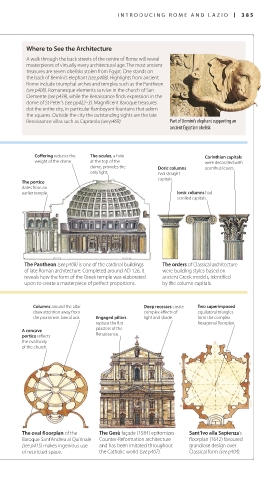
Where to See the Architecture
A walk through the back streets of the centre of Rome will reveal
masterpieces of virtually every architectural age. The most ancient
treasures are seven obelisks stolen from Egypt. One stands on
the back of Bernini’s elephant (see p408). Highlights from ancient
Rome include triumphal arches and temples such as the Pantheon
(see p408). Romanesque elements survive in the church of San
Clemente (see p439), while the Renaissance finds expression in the
dome of St Peter’s (see pp422–3). Magnificent Baroque treasures
dot the entire city, in particular flamboyant fountains that adorn
the squares. Outside the city the outstanding sights are the late
Renaissance villas such as Caprarola (see p469). Part of Bernini’s elephant support ing an
ancient Egyptian obelisk
Coffering reduces the The oculus, a hole Corinthian capitals
weight of the dome. at the top of the were decorated with
dome, provides the Doric columns acanthus leaves.
only light. had straight
capitals.
The portico
dates from an
earlier temple. Ionic columns had
scrolled capitals.
The Pantheon (see p408) is one of the cardinal build ings The orders of Classical archi tecture
of late Roman architecture. Completed around AD 126, it were building styles based on
reveals how the form of the Greek temple was elabor ated ancient Greek models, iden tified
upon to create a masterpiece of perfect proportions. by the column capitals.
Columns around the altar Deep recesses create Two superimposed
draw attention away from complex effects of equilateral triangles
the prominent lateral axis. Engaged pillars light and shade. form the complex
replace the flat hexagonal floorplan.
A concave pilasters of the
portico reflects Renaissance.
the oval body
of the church.
The oval floorplan of the The Gesù façade (1584) epitomizes Sant’Ivo alla Sapienza’s
Baroque Sant’Andrea al Quirinale Counter-Reformation architecture floorplan (1642) favoured
(see p415) makes in genious use and has been imitated throughout grandiose design over
of restricted space. the Catholic world (see p407). Classical form (see p404).
384-385_EW_Italy.indd 385 20/03/15 10:52 am

