


Page 435 - (DK Eyewitness) Travel Guide - Italy
P. 435
ROME : THE V A TIC AN AND TR ASTE VERE 433
Entirely rebuilt in the 1680s
by Cardinal Pallavicini, the
church is rich in 17th- and
18th-century sculptures. Not to
be missed in the Altieri chapel
(fourth left, along the nave) is
Bernini’s exquisite late work,
the Ecstasy of Beata Ludovica
Albertoni (1674).
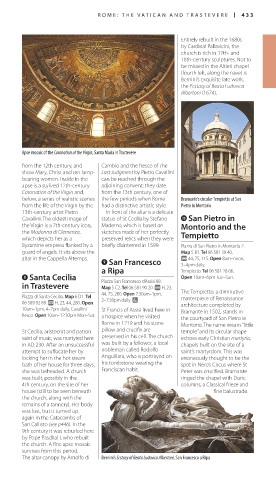
Apse mosaic of the Coronation of the Virgin, Santa Maria in Trastevere
from the 12th century, and Cambio and the fresco of The
show Mary, Christ and ten lamp- Last Judgment by Pietro Cavallini
bearing women. Inside in the can be reached through the
apse is a stylized 12th-century adjoining convent; they date
Coronation of the Virgin and, from the 13th century, one of
below, a series of realistic scenes the few periods when Rome Bramante’s circular Tempietto at San
from the life of the Virgin by the had a distinctive artistic style. Pietro in Montorio
13th-century artist Pietro In front of the altar is a delicate
Cavallini. The oldest image of statue of St Cecilia by Stefano 0 San Pietro in
the Virgin is a 7th-century icon, Maderno, which is based on Montorio and the
the Madonna di Clemenza, sketches made of her perfectly Tempietto
which depicts her as a preserved relics when they were
Byzantine empress flanked by a briefly disinterred in 1599. Piazza di San Pietro in Montorio 2.
guard of angels. It sits above the Map 5 B1. Tel 06 581 39 40.
altar in the Cappella Altemps. @ 44, 75, 115. Open 8am–noon,
9 San Francesco 3–4pm daily.
a Ripa Tempietto: Tel 06 581 28 06.
8 Santa Cecilia Open 10am–6pm Tue–Sun.
in Trastevere Piazza San Francesco d’Assisi 88.
Map 5 C2. Tel 06 581 90 20. @ H, 23,
Piazza di Santa Cecilia. Map 6 D1. Tel 44, 75, 280. Open 7:30am–1pm, The Tempietto, a diminutive
masterpiece of Renaissance
06 589 92 89. @ H, 23, 44, 280. Open 2–7:30pm daily. 7 architecture completed by
10am–1pm, 4–7pm daily. Cavallini St Francis of Assisi lived here in Bramante in 1502, stands in
fresco Open 10am–12:30pm Mon–Sat. a hospice when he visited the courtyard of San Pietro in
Rome in 1219 and his stone Montorio. The name means “little
St Cecilia, aristocrat and patron pillow and crucifix are temple” and its circular shape
saint of music, was martyred here preserved in his cell. The church echoes early Christian martyria,
in AD 230. After an unsuccessful was built by a follower, a local chapels built on the site of a
attempt to suffocate her by nobleman called Rodolfo saint’s martyrdom. This was
locking her in the hot steam Anguillara, who is portrayed on erroneously thought to be the
bath of her house for three days, his tombstone wearing the spot in Nero’s Circus where St
she was beheaded. A church Franciscan habit. Peter was crucified. Bramante
was built, possibly in the ringed the chapel with Doric
4th century, on the site of her columns, a Classical frieze and
house (still to be seen beneath fine balustrade.
the church, along with the
remains of a tannery). Her body
was lost, but it turned up
again in the Catacombs of
San Callisto (see p446). In the
9th century it was reburied here
by Pope Paschal I, who rebuilt
the church. A fine apse mosaic
survives from this period.
The altar canopy by Arnolfo di Bernini’s Ecstasy of Beata Ludovica Albertoni, San Francesco a Ripa
432-433_EW_Italy.indd 433 4/4/17 5:36 PM

