


Page 443 - (DK Eyewitness) Travel Guide - Italy
P. 443
ROME : A VENTINE AND LA TER AN 441
0 Protestant
Cemetery
Cimitero Acattolico, Via di Caio Cestio.
Map 6 D4. Tel 06 574 19 00. @ 23,
280. v 3. Open 9am–5pm Mon–Sat,
9am–1pm Sun. Last adm: 30 mins
before closing. Donation.
Non-Catholics have been buried
in this cemetery behind the
Aurelian Wall since 1738. In the
oldest part (on the left as you
enter) is the grave of the poet
John Keats, who died in 1821 in
Part of one of the gymnasia in the Baths of Caracalla a house on Piazza di Spagna (see
p412). He wrote his own epitaph:
8 Baths of Caracalla scavenged by the Farnese family “Here lies one whose name was
in the 16th century to adorn the writ in water”. Close by rest the
Viale delle Terme di Caracalla 52. Map
7 A3. Tel 06 39 96 77 00. @ 160, 628. rooms of Palazzo Farnese (see ashes of Percy Bysshe Shelley,
v 3. Open 9am–1 hour before p405). There are, however, statues who drowned in 1822.
sunset Tue–Sun, 9am–2pm Mon. and mosaics from the Baths in
Closed 1 Jan, 25 Dec. & 9 = the Museo Archeologico Nazio-
nale in Naples (see pp494–5) and
Rearing up at the foot of the in the Vatican’s Gregorian Profane
Aventine Hill are the monolithic Museum (see p426).
red-brick ruins of the Baths of So dramatic is the setting
Caracalla. Begun by Emperor that it is the regular venue
Septimius Severus in AD 206, for the open-air opera season
and completed by his son in summer.
Caracalla in AD 217, they
remained in use until the 6th 9 Pyramid of Caius
century, when the Goths
sabotaged the city’s aqueducts. Cestius
Going for a bath was one of Piazzale Ostiense. Map 6 E4. @ 23,
the social events of the day in 280. v 3. q Piramide. 8 only on 1st
ancient Rome. Large com- & 3rd Sat of month; call 06 574 31 93.
plexes such as Caracalla, with
a capacity for 1,600 bathers, Caius Cestius was a wealthy but
were not simply places to have unimportant 1st-century BC The interior of Santa Sabina
a natter and get washed, but praetor, or senior magistrate.
also areas which offered an At the time, inspired by the q Santa Sabina
impressive array of facilities: Cleopatra scandals, there was a Piazza Pietro d’Illiria 1. Map 6 D2.
art galleries, gymnasia, gardens, craze for all things Egyptian, and Tel 06 57 94 01. @ 23, 44, 170, 781.
libraries, conference rooms, Caius decided to commission Open 8:15am–12:30pm, 3:30–6pm
lecture rooms and shops himself a pyramid as a tomb. daily. 7
On Maundy selling food and drink. Set into the Aurelian Wall near
Thursday the pope, A Roman bath was a long Porta San Paolo, it is built of brick High on the Aventine stands an
as Bishop of Rome, and complicated business, and faced with white marble; early Christian basilica, founded
gives a blessing from beginning with a form of according to an inscription, it took by Peter of Illyria in AD 425 and
the loggia of the Turkish bath, followed by a just 330 days to build in 12 BC. later given to the Dominican
city’s main cathedral. spell in the caldarium, a large order. It was restored to its
hot room with pools of water original simplicity in the early
to moisten the atmosphere. 20th century. Light filters
Then came the lukewarm through 9th-century windows
tepidarium, followed by a visit onto a nave framed by pale
to the large central meeting Corinthian columns. Above the
place known as the frigidarium, main door is a blue and gold
and finally a plunge into the 5th-century mosaic inscription
natatio, an open-air swimming to Peter. In the side portico
pool. For the rich, this was outside is a 5th-century panelled
followed by a rub-down with door carved with biblical scenes,
scented woollen cloth. notably one of the oldest
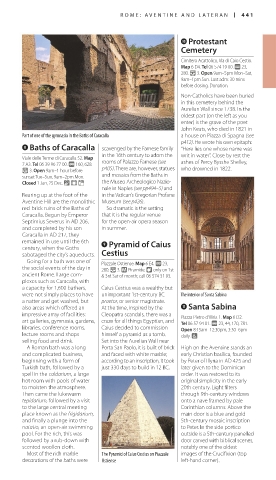
Most of the rich marble The Pyramid of Caius Cestius on Piazzale images of the Crucifixion (top
decorations of the baths were Ostiense left-hand corner).
440-441_EW_Italy.indd 441 26/04/16 5:19 pm

