


Page 75 - (DK Eyewitness) Travel Guide - Mallorca, Menorca & Ibiza
P. 75
M ALL ORC A 73
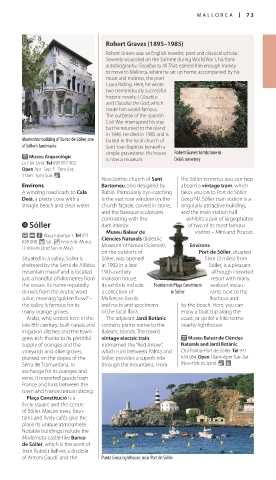
Robert Graves (1895–1985)
Robert Graves was an English novelist, poet and classical scholar.
Severely wounded on the Somme during World War I, his frank
autobiography, Goodbye to All That, earned him enough money
to move to Mallorca, where he set up home, accompanied by his
muse and mistress, the poet
Laura Riding. Here, he wrote
two tremendously successful
historic novels: I, Claudius
and Claudius the God, which
made him world-famous.
The outbreak of the Spanish
Civil War interrupted his stay
but he returned to the island
in 1946. He died in 1985 and is
Modernista building of Banco de Sóller, one buried in the local church of
of Sóller’s landmarks Sant Joan Baptista beneath a
simple gravestone. His house Robert Graves’ tombstone in
E Museu Arqueológic is now a museum. Deià’s cemetery
Es Clot Deià. Tel 699 957 902.
Open Apr–Sep: 5–7pm Sat,
11am–1pm Sun. &
Neo-Gothic church of Sant the Sóller terminus you can hop
Environs Bartomeu, also designed by aboard a vintage tram, which
A winding road leads to Cala Rubió. Particularly eye-catching takes you on to Port de Sóller
Deià, a pretty cove with a is the vast rose window on the (see p74). Sóller train station is a
shingle beach and clear water. church façade, carved in stone, singularly attractive building,
and the Baroque sculptures and the main station hall
contrasting with the exhibits a pair of large photos
e Sóller dark interior. of two of its most famous
Museu Balear de visitors – Miró and Picasso.
£ @ n Plaça Espanya 1. Tel 971
638 008. ( Sat. _ Festes de Moros Ciències Naturals (Balearic
i Cristians (2nd Sun in May). Museum of Natural Science), Environs
on the outskirts of Port de Sóller, situated
Situated in a valley, Sóller is Sóller, was opened 5 km (3 miles) from
sheltered by the Serra de Alfàbia in 1992 in a late Sóller, is a pleasant
mountain massif and is located 19th-century although crowded
just a handful of kilometres from mansion house. resort with many
the ocean. Its name reputedly Its exhibits include Fountain in Plaça Constitució seafood restau-
derives from the Arabic word a collection of in Sóller rants next to the
suliar, meaning “golden bowl” – Mallorcan fossils harbour and
the valley is famous for its and rocks and specimens by the beach. Here, you can
many orange groves. of the local flora. enjoy a boat trip along the
Arabs, who settled here in the The adjacent Jardí Botànic coast, or go for a hike to the
late 8th century, built canals and contains plants native to the nearby lighthouse.
irrigation ditches and the town Balearic Islands. The town’s
grew rich thanks to its plentiful vintage electric train, E Museu Balear de Ciències
supply of oranges and the nicknamed the “Red Arrow”, Naturals and Jardí Botànic
vineyards and olive groves, which runs between Palma and Ctra Palma–Port de Sóller. Tel 971
planted on the slopes of the Sóller, provides a superb ride 634 064. Open 10am–6pm Tue–Sat
Serra de Tramuntana. In through the mountains. From (Nov–Feb: to 2pm). & 7
exchange for its oranges and
wine, it imported goods from
France and links between the
town and France remain strong.
Plaça Constitució is a
lively square and the centre
of Sóller. Mature trees, foun-
tains and lively cafés give the
place its unique atmosphere.
Notable buildings include the
Modernista castle-like Banco
de Sóller, which is the work of
Joan Rubió i Bellver, a disciple
of Antoni Gaudí, and the Punta Grosa lighthouse, near Port de Sóller
072-073_EW_Mallorca.indd 73 06/10/17 11:08 am

