


Page 22 - (DK Eyewitness) Travel Guide - England's South Coast
P. 22
20 INTRODUCING ENGLAND ’ S SOUTH C O AST
Medieval Church Architecture
Romanesque architecture existed in England prior
to 1066, but it was the Normans who consolidated
it with a major programme of church building, from
modest parish churches to grandiose cathedrals.
The heavy solidity of Romanesque, with its rounded
arches, gave way to the lighter, pointed-arch style
of Gothic architecture introduced from France at the
end of the 12th century. The Gothic style developed
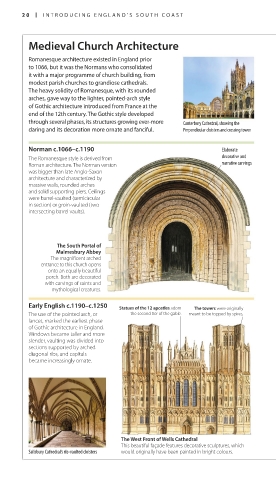
through several phases, its structures growing ever-more Canterbury Cathedral, showing the
daring and its decoration more ornate and fanciful. Perpendicular cloisters and crossing tower
Norman c.1066–c.1190 Elaborate
The Romanesque style is derived from decorative and
Roman architecture. The Norman version narrative carvings
was bigger than late Anglo-Saxon
architecture and characterized by
massive walls, rounded arches
and solid supporting piers. Ceilings
were barrel-vaulted (semicircular
in section) or groin-vaulted (two
intersecting barrel vaults).
The South Portal of
Malmesbury Abbey
The magnificent arched
entrance to this church opens
onto an equally beautiful
porch. Both are decorated
with carvings of saints and
mythological creatures.
Early English c.1190–c.1250 Statues of the 12 apostles adorn The towers were originally
The use of the pointed arch, or the second tier of the gable. meant to be topped by spires.
lancet, marked the earliest phase
of Gothic architecture in England.
Windows became taller and more
slender, vaulting was divided into
sections supported by arched
diagonal ribs, and capitals
became increasingly ornate.
The West Front of Wells Cathedral
This beautiful façade features decorative sculptures, which
Salisbury Cathedral’s rib-vaulted cloisters would originally have been painted in bright colours.
020-021_EW_ESC.indd 20 10/03/17 6:51 pm

