


Page 27 - (DK Eyewitness) Travel Guide - England's South Coast
P. 27
A POR TR AIT OF ENGLAND ’ S SOUTH C O AST 25
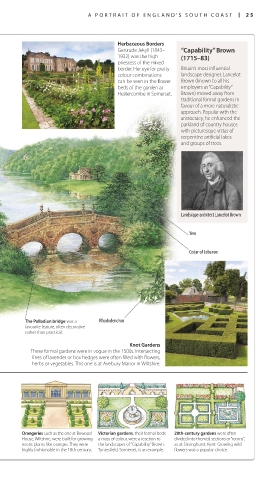
Herbaceous Borders
Gertrude Jekyll (1843– “Capability” Brown
1932) was the high (1715–83)
priestess of the mixed
border. Her eye for pretty Britain’s most influential
colour combinations landscape designer, Lancelot
can be seen in the flower Brown (known to all his
beds of the garden at employers as “Capability”
Hestercombe in Somerset. Brown) moved away from
traditional formal gardens in
favour of a more naturalistic
approach. Popular with the
aristocracy, he enhanced the
parkland of country houses
with picturesque vistas of
serpentine artificial lakes
and groups of trees.
Landscape architect Lancelot Brown
Yew
Cedar of Lebanon
The Palladian bridge was a Rhododendron
favourite feature, often decorative
rather than practical.
Knot Gardens
These formal gardens were in vogue in the 1500s. Intersecting
lines of lavender or box hedges were often filled with flowers,
herbs or vegetables. This one is at Avebury Manor in Wiltshire.
Orangeries such as the one at Bowood Victorian gardens, their formal beds 20th-century gardens were often
House, Wiltshire, were built for growing a mass of colour, were a reaction to divided into themed sections or “rooms”,
exotic plants like oranges. They were the landscapes of “Capability” Brown. as at Sissinghurst, Kent. Growing wild
highly fashionable in the 18th century. Tyntesfield, Somerset, is an example. flowers was a popular choice.
024-025_EW_ESC.indd 25 10/03/17 6:51 pm

