


Page 24 - (DK Eyewitness) Travel Guide - England's South Coast
P. 24
22 INTRODUCING ENGLAND ’ S SOUTH C O AST
Rural Architecture
Until the middle of the 19th century, most people lived
and worked in the country, with communities forming in or
around a village. The pattern of British villages dates back
some 1,500 years, when the Saxons established settlements
that were usually centred on a communal green or pond.
Most of today’s villages existed at the time of the Domesday
Book in 1086, though few buildings survive from then.
Settlements evolved organically around a church or manor,
with buildings created from local materials. Today, a typical
village contains structures of various dates, from the Middle
Ages onwards. The church is usually the oldest, followed Abbotsbury in Dorset, a typical rural
perhaps by a barn, a manor house or cottages. village built up around a church
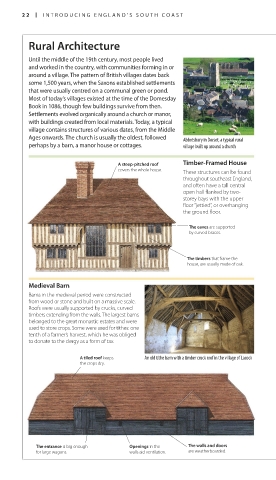
A steep-pitched roof Timber-Framed House
covers the whole house. These structures can be found
throughout southeast England,
and often have a tall central
open hall flanked by two-
storey bays with the upper
floor “jettied”, or over hanging
the ground floor.
The eaves are supported
by curved braces.
The timbers that frame the
house, are usually made of oak.
Medieval Barn
Barns in the medieval period were constructed
from wood or stone and built on a massive scale.
Roofs were usually supported by crucks, curved
timbers extending from the walls. The largest barns
belonged to the great monastic estates and were
used to store crops. Some were used for tithes: one
tenth of a farmer’s harvest, which he was obliged
to donate to the clergy as a form of tax.
A tiled roof keeps An old tithe barn with a timber cruck roof in the village of Lacock
the crops dry.
The entrance is big enough Openings in the The walls and doors
for large wagons. walls aid ventilation. are weatherboarded.
022-023_EW_ESC.indd 22 05/04/17 3:06 pm

