


Page 35 - (DK Eyewitness) Travel Guide - England's South Coast
P. 35
INTRODUCING ENGLAND ’ S SOUTH C O AST 33
THE HISTORY OF
ENGLAND’S SOUTH COAST
A mere 32 km (20 miles) from France at its closest point, the South Coast has acted
as England’s defensive bulwark ever since the last successful invasion in 1066.
Southern shipbuilding and maritime expertise were crucial in helping establish the
country as a great imperial power, making ports such as Bristol and London, and
the great naval bases of Portsmouth and Southampton, incredibly wealthy. In more
recent times, the South Coast’s proximity to London and Europe, its dramatic history
and its sheer beauty have made it a magnet for tourists from across the globe.
In the distant past, England’s South ago, around the start of the Mesolithic
Coast was joined to continental period. Mesolithic, or Stone Age,
Europe by a chalk ridge running settlers were hunter-gatherers who
between the Weald in southern used flint-tipped spears and arrows
England and Artois in northeastern to hunt wild animals. Important
France. The first human settlers are Mesolithic sites include the Mendip
thought to have arrived in Britain via Hills in Somerset and Bouldnor Cliff on
the ridge around 900,000 years ago, the Isle of Wight. The next wave of
during an interglacial period. They Celtic Battersea Shield arrivals introduced farming to Britain
were probably hunter-gatherers, from the Iron Age in around 4000 BC, clearing away
and have been classified as Homo woodland for domesticated animals
antecessor. Subsequent ice ages either and plants in what would become known
wiped them out, or sent them heading as the Neolithic period. They constructed
back south to escape the extreme cold. defendable causewayed camps, made long
Sometime between 450,000 and 200,000 barrows to bury their dead and built
years ago, a huge glacial lake to the north of mysterious henges, the most famous being
the Weald–Artois ridge overflowed, gouging Stonehenge and Avebury, both in Wiltshire.
a deep channel through it and into the During the Bronze and Iron Ages,
Atlantic. When sea levels rose between the beginning around 2300 BC, the creation
ice ages, the channel formed a permanent of tools and artifacts became more
barrier between Britain and the Continent. sophisticated. Some of the most beautiful
The South Coast, especially the South objects were made by the various warlike
West, abounds in prehistoric sites. The oldest tribes who arrived in Britain around
complete skeleton of a modern human 550 BC. Loosely described as Celts, they
was found in caves at Cheddar Gorge in were not a unified people, but their
Somerset and dates from about 9,000 years cultures and languages overlapped.
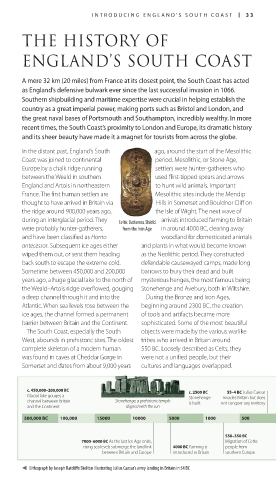
c. 450,000–200,000 BC c. 2500 BC 55–4 BC Julius Caesar
Glacial lake gouges a Stonehenge invades Britain but does
channel between Britain Stonehenge, a prehistoric temple is built not conquer any territory
and the Continent aligned with the sun
500,000 BC 100,000 15000 10000 5000 1000 500
550–350 BC
7000–6000 BC As the last Ice Age ends, Migration of Celtic
rising sea levels submerge the land link 4000 BC Farming is people from
between Britain and Europe introduced to Britain southern Europe
Lithograph by Joseph Ratcliffe Skelton illustrating Julius Caesar’s army landing in Britain in 54 BC
032-037_EW_ESC.indd 33 10/03/17 6:51 pm

