


Page 39 - (DK Eyewitness) Travel Guide - England's South Coast
P. 39
THE HIST OR Y OF ENGLAND ’ S SOUTH C O AST 37
another reversal when James II was ousted across the country. By 1850, it was possible
from power for his Catholic leanings. His to travel from London to Dover, Brighton,
daughter Mary II and son-in-law William Portsmouth, Bristol and Exeter by train.
of Orange became the new, staunchly The era’s greatest engineer, Isambard
Protestant, joint monarchs in 1689. Kingdom Brunel, was the chief designer
for the Great Western Railway. He also
The Georgians created spectacular ships, including the
The expansion of the British Empire in the SS Great Britain, the world’s first iron-hulled
18th century meant increased trade, much steamship, launched from Bristol in 1843.
of it facilitated by slavery, but also several
expensive wars. The resultant high taxation, Modern Times
especially on imported luxuries, led to Shipbuilding was still a major industry at the
smuggling along the entire length of start of the 20th century, and many British
the South Coast. As wealth increased, battleships were built in Portsmouth and
so leisure became more Devonport. When the British
sophisticated. Spa towns, Army was stranded in France in
such as Royal Tunbridge Wells 1940, during World War II, naval
and Bath, became increasingly vessels and other private boats
fashionable and seaside evacuated over 300,000 soldiers
resorts began to proliferate. from the beaches of Dunkirk.
The quiet Sussex village of Four years later, some 5,000
Brighthelmstone developed naval vessels set off from ports
into the popular seaside resort across the entire South Coast
of Brighton after the Prince as part of the Allied D-Day
Regent built his exotic Royal invasion of France. After the
Pavilion there in 1787. The historic iron-hulled steamship, war, traditional industries,
The threat of French invasion SS Great Britain, designed by Brunel such as fishing and agriculture,
loomed throughout the 18th declined. The economy
century and, following the French became more diverse, with leisure pursuits
Revolution, Britain was at war with France and tourism playing a big role. The opening
from 1792 to 1815. Invasion plans ended of the Channel Tunnel in 1994 provided a
in 1805, when Lord Nelson’s fleet defeated physical link to mainland Europe, but Britain’s
Napoleon’s navy at the Battle of Trafalgar. close ties to the Continent suffered a setback
in 2016 when the electorate voted for
The Victorian Era withdrawal from the European Union (EU)
The invention of the steam train and the following 43 years of membership. Despite
railway boom of the 1840s caused an this, the South Coast is likely to remain an
infrastructure revolution as raw materials increasingly attractive prospect for the
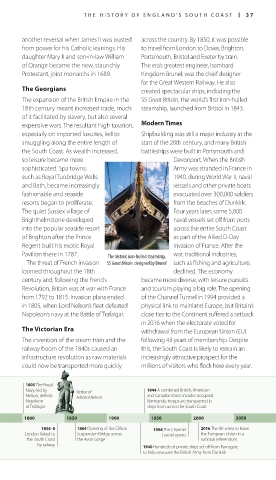
could now be transported more quickly millions of visitors who flock here every year.
1805 The Royal
Navy, led by Statue of 1944 A combined British, American
Nelson, defeats Admiral Nelson and Canadian force invades occupied
Napoleon Normandy; troops are transported in
at Trafalgar ships from across the South Coast
1750 1800 1850 1900 1950 2000 2050
1836–8 1864 Opening of the Clifton 1994 The Channel 2016 The UK votes to leave
London linked to Suspension Bridge across Tunnel opens the European Union in a
the South Coast the Avon Gorge national referendum
by railway 1940 Hundreds of private ships set off from Ramsgate
to help evacuate the British Army from Dunkirk
032-037_EW_ESC.indd 37 10/03/17 6:51 pm

